
DATANORM provides a standardized foundation for exchanging product and pricing data between manufacturers, wholesalers and skilled trade businesses. By reducing manual data maintenance and improving process continuity, it enables faster quotations, more reliable purchasing workflows and cleaner operational processes. As structured data becomes increasingly important for automation and AI-supported systems, DATANORM remains a critical digital foundation across the construction and technical trades industry.
For many construction and skilled trade companies, digital transformation does not begin with artificial intelligence or advanced automation platforms. It starts with something far more practical and far more important in daily operations: reliable product and pricing data.
Manufacturers constantly update catalogs, wholesalers adjust prices, product ranges expand and availability changes almost daily. Without standardized processes, businesses often spend enormous amounts of time manually maintaining article databases, updating spreadsheets or correcting quotation errors. This is exactly where DATANORM has played a critical role in the German-speaking construction industry for decades.
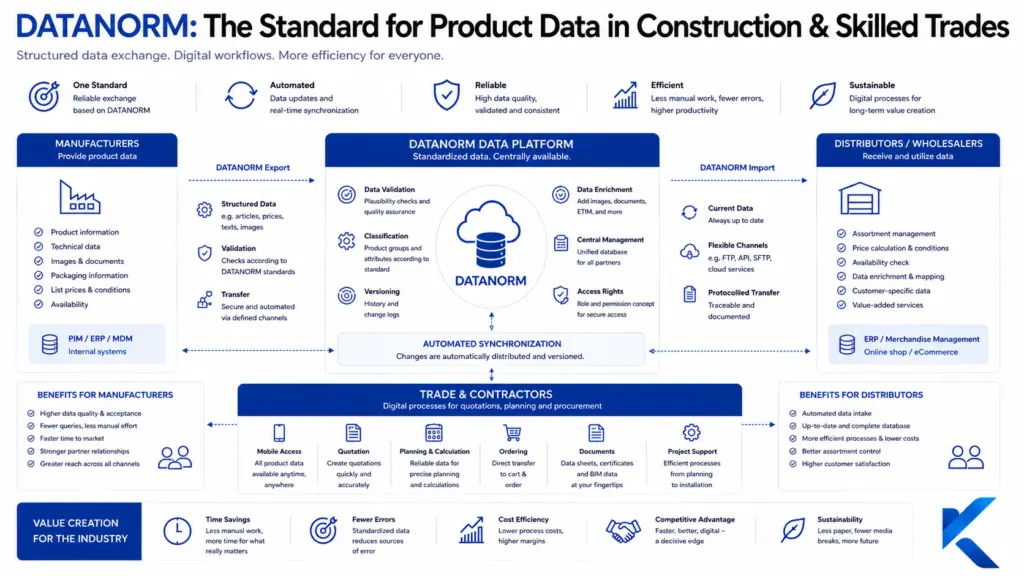
DATANORM was designed as a standardized method for exchanging product and master data between manufacturers, wholesalers and trade businesses. While the concept sounds technical at first, its operational impact is significant. Instead of manually entering product numbers, descriptions, prices and packaging units into internal software systems, companies can import structured data directly from suppliers into their existing workflows.
In practical terms, this changes how businesses operate every single day. Electrical contractors, HVAC companies, construction suppliers and technical service providers work with thousands of products simultaneously. Managing that information manually is not only inefficient but increasingly unrealistic. Modern projects move too quickly, margins are often tight and customers expect fast response times.
The real strength of DATANORM is therefore not simply file compatibility. Its value lies in process continuity. Once supplier data is integrated properly, quotations can be generated faster, material calculations become more reliable and ordering processes require significantly less manual coordination.
A common example can be seen in HVAC projects. Imagine a technician or project manager visiting a customer to discuss a heating system replacement. Instead of returning to the office later to manually research products and pricing, all required supplier data is already available inside the company system. Components can be selected immediately, pricing structures applied automatically and material requirements prepared on-site. In many cases, orders can even be triggered directly after the customer meeting.
This becomes even more valuable when combined with mobile workflows. Many skilled trade companies no longer want operational data tied exclusively to office computers. Employees expect access to pricing data, catalogs and material information from smartphones, tablets or cloud-based applications while working on-site. DATANORM remains highly relevant in this environment because it continues to provide a stable and widely accepted foundation for structured product exchange.
Another important factor is consistency. Structured master data is no longer used only for quotations. The same information often feeds purchasing, warehouse management, invoicing, project planning and profitability analysis. If product data is outdated or inconsistent, the effects spread across the entire organization. Small errors in material pricing or product assignments can eventually reduce margins or create expensive procurement issues.
This is why many companies increasingly invest in centralized data structures and connected interfaces. Alongside DATANORM, additional standards such as IDS-Connect, SHK-Connect, UGL and GAEB support broader digital collaboration across suppliers, contractors and project stakeholders. Together, these interfaces create a more connected operational environment with fewer manual interruptions.
The topic is also becoming highly relevant in the context of AI and automation. Structured product data enables modern systems to prepare quotations automatically, suggest matching materials, identify alternatives or analyze purchasing patterns over time. Businesses that maintain clean and standardized data structures today are effectively building the foundation for future AI-supported workflows.
Many companies still underestimate the hidden cost of manual data maintenance. The problem is not just the time spent entering information. Incorrect article numbers, outdated prices or incomplete descriptions often create downstream problems later during ordering, billing or project execution. These operational inefficiencies may remain invisible at first but can significantly affect profitability over time.
Although DATANORM has existed for many years, that longevity is actually one of its greatest strengths. Few standards have become as deeply embedded across the German construction and skilled trade ecosystem. Because manufacturers, wholesalers and software vendors continue to support it broadly, DATANORM remains one of the most important digital foundations for operational efficiency in the industry.
As construction projects become more complex and businesses increasingly depend on fast digital workflows, structured product data will continue gaining strategic importance. Companies that organize their data properly and integrate standardized interfaces consistently position themselves for faster quotations, cleaner operations and better decision-making across the entire business.
FAQ
What is DATANORM?
DATANORM is a standardized format for exchanging product and pricing data between manufacturers, wholesalers and trade businesses.
Why is DATANORM still relevant today?
Because it provides a stable and widely supported foundation for structured product data workflows across the construction and skilled trades industry.
Which industries typically use DATANORM?
DATANORM is widely used in HVAC, electrical, construction supply and technical service industries.
How does DATANORM support automation?
Structured product data enables faster quotations, automated purchasing workflows and AI-supported analysis or recommendation systems.
Further reading
- DATANORM Online – Official Information About the Standard
https://www.datanorm.de/ - ZVEH – Digitalisierung im Elektrohandwerk
https://www.zveh.de/ - BVBS – Standards for Digital Construction Processes
https://www.bvbs.de/
All articles about industry solutions
