
Autonomous AI agents are software systems that translate a defined goal into work steps, use tools, and evaluate intermediate results with limited supervision. Unlike conventional chatbots, they do not merely generate responses; they execute bounded processes. Mid-sized companies benefit when tasks, permissions, spending limits, and human approvals are deliberately built into the operating model.
What are autonomous AI agents?
An autonomous AI agent is not an independent digital employee with unlimited authority. It is a software component designed to pursue a specific business objective within an approved operating boundary. The agent receives a goal, accesses permitted information, selects from available tools, and determines which work step should happen next.
A basic agent might read an incoming service request, identify the affected product, search the document management system, and prepare a response. A more advanced version could verify the customer record in the CRM, create a support ticket, propose a priority, retrieve the relevant service history, and route the case to the appropriate employee.
Autonomy therefore does not mean unrestricted freedom. It means that the system can complete multiple related steps, evaluate intermediate results, and adapt its next action without requesting a new instruction after every operation. People still define the objective, approved data sources, available tools, escalation rules, and actions that require authorization.
Amazon Web Services describes agentic AI in similar terms: a goal-oriented system that can act independently within a defined context and use external resources to perform complex tasks.
How are autonomous AI agents different from traditional software and chatbots?
Traditional business software generally follows deterministic logic. A workflow starts when a specific event occurs, processes predefined rules, and produces an expected output. A generative AI assistant is more flexible, but it usually waits for a prompt and returns content that an employee reviews and uses.
Autonomous AI agents combine generative models with workflow orchestration, tool access, memory, business policies, and execution capabilities. This allows them to move beyond producing information and participate in operational work.
| Characteristic | Traditional workflow software | Generative AI assistant | Autonomous AI agent |
|---|---|---|---|
| Starting point | Event or predefined rule | Individual user prompt | Goal, assignment, or business event |
| Process | Programmed in advance | Produces a response | Plans and executes multiple work steps |
| System access | Fixed integrations | Often limited to information retrieval | Tools, APIs, databases, and business applications |
| Handling deviations | Predefined exception path | Requires another prompt | Evaluates the outcome and selects another action |
| Employee role | Operate the workflow and handle exceptions | Review and use generated content | Define authority, approvals, policies, and escalation |
| Typical risk | Defective rule or integration | Incorrect generated content | Incorrect output followed by an operational action |
The final distinction matters most in production. An inaccurate draft is inconvenient. An agent that uses the same inaccurate information to update a customer record, send a message, place an order, or modify a service schedule can affect an actual business transaction.
Bring AI into daily operations in a structured way
The KrambergAI AI Introduction helps companies select suitable use cases, prepare workflows and integrate AI solutions into everyday operations in a controlled and practical way.
Structured implementation · Practical guidance · Made in Germany
How does an autonomous AI agent work?
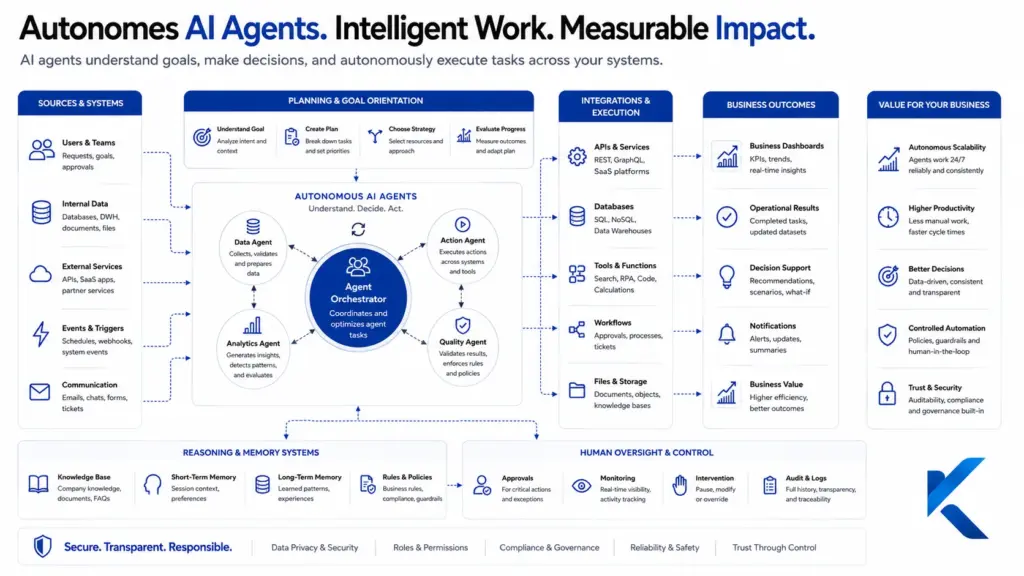
The reasoning component is often a large language model or a smaller domain-specific model. The model alone, however, does not create a production-ready agent. Additional components turn language processing into a controlled execution system.
An orchestration layer manages the run and determines which capability should be used next. A tool registry describes available APIs, search functions, databases, and applications. A knowledge layer provides internal documents, product data, process instructions, and historical cases. Memory components retain relevant state. Authorization policies restrict access. Evaluation mechanisms inspect results, and audit logs record which action was performed with which inputs.
A typical run begins when the agent interprets an assignment and identifies the information it needs. It calls an approved tool, evaluates the result, and selects the next step. The run ends when the objective has been achieved, a spending limit has been reached, a policy would be violated, required information is missing, or a human decision is needed.
In a business environment, the most useful mental model is not an unrestricted chatbot. It is a digital process participant with an assigned role, limited system privileges, explicit operating policies, and a documented escalation path.
Which business use cases are suitable for autonomous AI agents?
The strongest candidates are repetitive workflows with structured input, accessible data sources, verifiable outputs, and limited downside when something goes wrong. The agent should be able to determine whether a case has been completed and when it must be handed to an employee.
In customer service, an agent can classify emails and forms, retrieve account information, search approved support content, prepare a response, and create a ticket. In sales, it can qualify an inquiry, identify missing information, enrich the CRM record, and prepare input for a quote. In procurement, an agent can compare requested quantities with existing inventory, collect supplier information, and prepare a purchase recommendation.
Field service organizations can use agents to structure equipment issues, retrieve maintenance history, assemble technician instructions, and suggest scheduling options. Manufacturing companies can use them to consolidate quality reports, compare a deviation with documented procedures, and prepare a corrective-action case. Construction and skilled-trade businesses can use agents to sort project inquiries, verify whether required site information is present, and prepare handoffs to estimating or dispatch.
Administrative functions also offer practical opportunities. Agents can perform formal invoice checks, summarize contract deadlines, consolidate project updates from several applications, request missing documentation, or prepare management reports. The final posting, payment authorization, contractual commitment, or vendor selection should initially remain with the responsible employee.
Poor candidates include one-time assignments without dependable information, sensitive employment decisions, activities with consequences that cannot be reversed, and workflows whose rules vary widely between employees and locations.
Where does the financial value come from?
Most companies will not create value by replacing an entire job with one agent. The more common benefit is a reduction in searching, rekeying, follow-up questions, fragmented handoffs, and routine coordination. Employees receive a better-prepared case instead of collecting information manually from email, shared drives, ERP, CRM, ticketing systems, and specialized applications.
Current research also shows a substantial gap between experimentation and scaled operation. Capgemini reports that only 2 percent of surveyed organizations have deployed AI agents at full scale, while 23 percent are running pilots. In a PwC survey, 66 percent of organizations adopting agents reported measurable productivity value. An Accenture study found that 77 percent of executives believe the full benefits of AI depend on a foundation of trust. These are international business surveys rather than forecasts specifically representing German or US mid-market companies.
A credible financial model must include more than labor minutes. Companies need to account for model calls, tool usage, data transfer, infrastructure, integration, monitoring, policy maintenance, exception handling, employee review, and remediation. An agent that completes a routine task quickly but creates frequent corrections may cost more than the original process.
Useful operating metrics include cycle time, employee effort, error rates, first-pass completion, escalation frequency, handoff quality, and cost per completed case. Authority should be expanded only after these measurements remain acceptable across routine cases and realistic exceptions.
Why do agent projects fail after a successful demonstration?
Demonstrations are usually conducted with carefully selected examples, curated documents, and stable connections. Production environments contain incomplete requests, inconsistent master data, outdated files, ambiguous language, failed integrations, duplicate records, and unusual customer situations.
One recurring mistake is giving the agent an assignment that is too broad. The same agent is expected to research, interpret policy, make a decision, communicate externally, and modify systems. When the result is wrong, the team cannot easily determine which stage failed. Smaller operating roles with inspectable inputs and outputs are easier to test and maintain.
Excessive permissions create another problem. An agent may receive access to an entire mailbox, CRM environment, shared drive, or database even though its task requires only a narrow subset. This increases security exposure and gives the model more opportunities to use irrelevant or outdated material.
Projects also stall when process ownership is missing. The IT team can maintain the technical platform, but someone in the business must decide how exceptions are handled, which documents are authoritative, which actions are permitted, and what level of quality is acceptable. An agent cannot be treated as a one-time software installation. Its business process, data sources, tools, and evaluation criteria require ongoing ownership.
How much autonomy should a company permit?
Autonomy should be introduced as a progression rather than a binary choice.
At the first stage, the agent receives read-only access and assembles information. It can then prepare drafts that an employee reviews. Once results are dependable, it may create recommendations, proposed record changes, transaction packages, or scheduling options. Only after production-like testing should it execute low-risk actions without individual approval.
The appropriate stage depends on the consequences of failure, not solely on model capability. Sending an internal status update is different from changing a customer price, authorizing a payment, accepting a contract, making an employment decision, or altering a safety-related schedule.
Human approvals should therefore be positioned at consequential decision points rather than inserted before every minor step. Low-impact and reversible work can receive more automation. Decisions with financial, legal, personal, regulatory, or safety implications should remain under the authority of an accountable employee.
Companies should also separate the authority to recommend from the authority to execute. An agent may be highly effective at comparing options and preparing a decision package while remaining unable to commit the company to the proposed action.
What risks are created when agents can take action?
AI agents increase the attack surface because they interpret content and operate tools. A manipulated email, document, web page, or support ticket may contain instructions that the agent mistakes for part of its assignment. This is commonly described as indirect prompt injection.
Additional risks include excessive privileges, poisoned long-term memory, compromised extensions, unreliable tool execution, unauthorized data disclosure, and flawed handoffs between multiple agents. The OWASP Generative AI Security Project has developed dedicated threat categories and mitigation guidance for agentic applications.
Technical safeguards include separate service identities, least-privilege access, isolated execution environments, approved tool lists, input validation, transaction limits, network restrictions, and tamper-resistant logging. Actions that modify data should support reversal, correction, or controlled replay whenever the underlying system allows it.
A production agent also needs a business stop condition. It should suspend the case when required data is unavailable, evidence conflicts, a budget is exceeded, an application behaves unexpectedly, or the situation falls outside its approved policy. A dependable agent is not merely capable of acting; it is capable of refusing to continue when the operating conditions are not met.
Use AI Agents where they create real relief
KrambergAI AI Employees take on clearly defined tasks in service or administration and work with existing company knowledge along agreed processes.
Implemented pragmatically · Designed around real tasks · Made in Germany
How can companies control reliability and operating costs?
An agent can generate unnecessary model and tool calls when it repeatedly searches for the same information, explores multiple approaches without a termination rule, or retries a failed integration indefinitely. These agent loops consume time and money without moving the case toward completion.
Each run should have a time budget, tool budget, model budget, and retry limit. High-volume routine steps can often be handled by smaller models, deterministic rules, or traditional automation. More capable models should be reserved for work that genuinely requires complex language interpretation, document comparison, or contextual judgment.
Monitoring must go beyond system errors. Companies should measure duration, cost per case, tool-call volume, stop reasons, escalation rates, employee corrections, and recurring exception patterns. These signals show whether the agent is improving business throughput or merely creating a new layer of operational overhead.
A common practical lesson is that not every step should be agentic. A cost-effective design may use an agent to interpret an incoming request and choose the appropriate process path. A deterministic workflow then executes the transaction. This retains flexible language handling while keeping the business operation reproducible.
Caching, retrieval filters, reusable intermediate results, and model routing can further reduce cost. However, cost optimization should not remove the verification steps required for consequential actions.
Who remains responsible for decisions made with an AI agent?
An AI agent can execute a task, but it cannot assume corporate accountability. Every production agent needs a business process owner, a technical operator, and designated contacts for information security, privacy, and compliance.
The process owner defines the expected outcome, approved sources, exception rules, and acceptance criteria. The technical operator is responsible for availability, model and agent versions, integrations, logs, incident handling, and recovery. Business approvers retain authority over cases with elevated consequences.
These responsibilities must be implemented in the workflow rather than described only in a policy document. Roles, authorization thresholds, escalation routes, and backup owners should be part of the operating system. When an agent reaches its boundary, the case should be transferred with the original request, retrieved evidence, completed actions, failed attempts, and outstanding questions.
This approach avoids a common operational failure: the agent stops, but the employee receiving the case has to reconstruct the entire history manually.
How can the EU AI Act affect autonomous AI agents?
The EU AI Act does not regulate every agent under one universal category. The relevant obligations depend on the intended purpose, affected people, degree of autonomy, data processing, and consequences of the system’s decisions or actions.
According to the European Commission’s AI Act Service Desk, transparency obligations may apply from August 2, 2026 when an agent interacts with natural persons or generates certain content. Additional requirements may apply when the overall system qualifies as a high-risk AI system because of its intended use.
The commercial label used by a vendor does not determine the legal classification. An internal document-search agent presents a different regulatory profile from a system that assesses job applicants, affects access to essential services, or controls safety-related equipment.
Companies operating in or serving the European Union should maintain an inventory of deployed agents, documented purposes, responsible owners, data sources, permissions, model versions, evaluations, incidents, and approval rules. These records also support troubleshooting, vendor management, security reviews, and future platform migration.
US companies should separately assess applicable privacy, employment, consumer protection, industry, contractual, and state-level requirements. A system may be outside a European high-risk category while still creating material legal or operational obligations elsewhere.
How should a mid-sized company get started?
A productive starting point is a specific operational bottleneck rather than a search for the most universal agent platform. The selected workflow should occur regularly, consume measurable employee effort, and produce an outcome that can be evaluated.
The team first documents the actual process: incoming information, applications used, decisions made, exceptions encountered, and final output. It then assigns the agent a limited portion of that process. During the initial phase, the agent should primarily read, organize, compare, and prepare. Consequential actions remain unavailable or require approval.
Testing should use realistic protected data and include difficult cases, not only ideal examples. The test set should contain missing fields, conflicting documents, unusual file formats, duplicate records, unavailable systems, ambiguous messages, and policy exceptions. A pilot that succeeds only with carefully prepared inputs provides little evidence about production performance.
After testing, the organization reviews employee corrections, processing time, cost, escalation volume, security events, and user adoption. Additional data sources, tools, or write permissions are introduced only when the existing configuration performs dependably.
This progression may appear less ambitious than launching a fully autonomous digital workforce. In practice, it creates a more useful outcome: an agent that employees trust with a bounded task and that the company can operate, audit, improve, and stop when necessary.
What is an autonomous AI agent?
An autonomous AI agent is software that can break a defined objective into work steps, retrieve information, and use approved tools. It evaluates intermediate outcomes and selects its next action within an operating policy. People continue to determine the assignment, permissions, data sources, spending limits, escalation conditions, and approvals required for consequential decisions.
Are autonomous AI agents the same as chatbots?
No. A chatbot primarily answers questions or generates content after a user request. An autonomous AI agent can also access business applications, plan a sequence of actions, and prepare or execute operational steps. The boundary can overlap because modern chat interfaces may use tools, but an agent independently manages a multi-step task toward an assigned outcome.
Can autonomous AI agents replace employees?
Agents can take over substantial portions of highly standardized work, especially searching, classification, data preparation, and routine coordination. A complete job usually also includes judgment, communication, prioritization, exception handling, and accountability. In most organizations, job content will change: agents prepare and process cases while employees retain authority over sensitive decisions, unusual situations, and quality.
Does an AI agent need access to all company information?
No. An agent should access only the information required for its assignment. A service agent may need product documentation and selected customer records but not employee files or strategic financial plans. Separate knowledge spaces, filtered APIs, field-level access, and role-specific service identities reduce exposure and prevent unrelated or outdated information from influencing the agent’s work.
Which processes should not be delegated to autonomous AI agents?
Poor candidates include workflows with undocumented rules, outcomes that are difficult to verify, or consequences that cannot be reversed. Employment decisions, legally binding contract acceptance, major payments, and safety-critical controls require particular caution. Agents may collect evidence and prepare recommendations in these areas, but final authority should remain with an appropriately qualified and accountable person.
How can a company control the ongoing cost of an AI agent?
Each run should have limits for time, tool calls, model usage, and retries. Repetitive steps can be routed to smaller models or deterministic workflows. Companies should monitor cost per completed case, repeated failures, employee corrections, and unnecessary tool activity. These measurements reveal whether the agent is improving throughput or creating expensive computational activity without a corresponding business result.
How can business data be protected from an AI agent?
The agent should use a dedicated technical identity with least-privilege access. Data sources are separated according to the task, role, and sensitivity level. Write access, exports, and external communication require additional controls. Logs record data retrieval and tool use. Sensitive information should be processed only when purpose, authorization, storage location, retention, and deletion have been addressed.
What happens when an autonomous AI agent makes a mistake?
The organization should be able to reconstruct the case from inputs, retrieved evidence, tool calls, outputs, and approvals. Data-changing actions should support reversal or correction whenever possible. The agent stops and escalates unusual behavior. The team then fixes the immediate outcome and determines whether the operating policy, source data, prompt, model, tool integration, or evaluation process requires modification.
What role do people have when autonomous AI agents are deployed?
People define objectives, operating limits, accountability, and quality expectations. They handle exceptions, review sensitive decisions, and approve changes to the system. Their work shifts from completing every routine step toward supervising outcomes and resolving difficult cases. Human involvement remains essential whenever an error could create substantial financial, legal, personal, regulatory, or safety consequences.
How long does it take to deploy an autonomous AI agent?
The timeline depends more on the workflow, data sources, integrations, and risk profile than on the language model. A bounded read-and-prepare agent may be piloted relatively quickly. Write access, numerous exceptions, legacy applications, and regulated decisions require additional engineering and testing. The implementation plan should reserve adequate time for realistic edge cases, monitoring, ownership, and production support.
Further reading
Amazon Web Services: What is Agentic AI?
https://aws.amazon.com/what-is/agentic-ai/
An introduction to goal-oriented systems, tool use, and the differences among traditional software, generative AI, and agentic applications.
OWASP: Top 10 for Agentic Applications 2026
https://genai.owasp.org/resource/owasp-top-10-for-agentic-applications-for-2026/
A practitioner-focused overview of major security risks affecting autonomous and agentic applications.
European Commission: How are AI agents addressed within the AI Act?
https://ai-act-service-desk.ec.europa.eu/en/ai-act/faq/how-are-ai-agents-addressed-within-ai-act-0
The European Commission’s official discussion of transparency and potential high-risk requirements for AI agents.
Sources for the statistics used
Capgemini Research Institute: Rise of agentic AI
https://www.capgemini.com/insights/research-library/ai-agents/
Statistics used: organizations operating agents at full scale and organizations running pilots.
PwC: AI Agent Survey
https://www.pwc.com/us/en/tech-effect/ai-analytics/ai-agent-survey.html
Statistic used: adopters reporting measurable productivity value.
Accenture: Technology Vision 2025
https://newsroom.accenture.com/news/2025/accenture-technology-vision-2025-new-age-of-ai-to-bring-unprecedented-autonomy-to-business
Statistic used: executives who consider trust foundational to realizing AI benefits.
