AI agent ecosystems connect specialized agents that divide work, exchange information, and jointly execute business processes. For mid-market companies, this creates scalable automation when orchestration, data access, and accountability are designed around real workflows. The decisive factor is not the number of agents, but whether each agent has a bounded role, traceable handoffs, and proportionate controls.
Why is one AI agent often insufficient for complex business processes?
A single AI agent can search documents, draft emails, retrieve CRM records, or summarize information from an ERP platform. Once a process crosses several business domains, data sources, and permission levels, however, the general-purpose agent can become the bottleneck. It must manage too many tools, reconcile competing objectives, and determine which action is permitted in each connected system.
Use AI Agents where they create real relief
KrambergAI AI Employees take on clearly defined tasks in service or administration and work with existing company knowledge along agreed processes.
Implemented pragmatically · Designed around real tasks · Made in Germany
An AI agent ecosystem distributes these responsibilities across specialized components. One agent may interpret an incoming customer request, another may examine technical documentation, a scheduling agent may check capacity, and an offer agent may prepare a commercial draft. An orchestrator assigns the work, evaluates intermediate results, and brings an employee into the process when predefined conditions occur.
This design resembles a digitally supported operating model rather than an all-knowing chatbot. Each agent receives a role, an operating boundary, approved data sources, and a limited toolset. Specialization does not eliminate every failure mode, but it makes access paths, responsibilities, and operational limits easier to manage.
Anthropic describes multi-agent systems as particularly useful for open-ended work in which subagents investigate different dimensions in parallel and return condensed results to a lead agent. The same architecture introduces additional coordination, evaluation, and reliability challenges that must be engineered deliberately.
How quickly are AI agent ecosystems entering business operations?
The market is moving from isolated demonstrations toward operational agent platforms. Capgemini Research Institute reported that 21 percent of surveyed enterprises were already using multi-agent systems in 2025. McKinsey found that 23 percent of surveyed organizations were scaling agentic AI in at least one business function.
Technical standardization is advancing at the same time. In April 2026, the Linux Foundation reported that the open Agent-to-Agent protocol was supported by more than 150 organizations. Adoption does not remove governance risk, however. Gartner predicts that by 2027, 40 percent of enterprises will demote or decommission autonomous agents after governance gaps are discovered through production incidents.
For mid-market companies, these findings do not justify building a large autonomous network immediately. They indicate that platforms and interoperability standards are becoming more mature while operating discipline remains a decisive factor. A valuable pilot therefore begins with a commercially relevant workflow, measurable outcomes, and bounded authority rather than a large agent count.
How is an AI agent ecosystem structured?
Most ecosystems include an orchestration layer at the center. It receives a request, decomposes it into work packages, selects appropriate agents, and manages process state. Depending on the use case, this layer may be a central supervisor, a deterministic workflow engine, an event-driven process controller, or a hybrid of these approaches.
Specialized agents operate beneath that layer. A knowledge agent retrieves approved documents, a data agent reads business records, an analysis agent evaluates the findings, and an action agent transfers an approved change into an operational system. Each agent does not necessarily require a different language model. Several agents may share the same model platform while using different instructions, permissions, tools, and context.
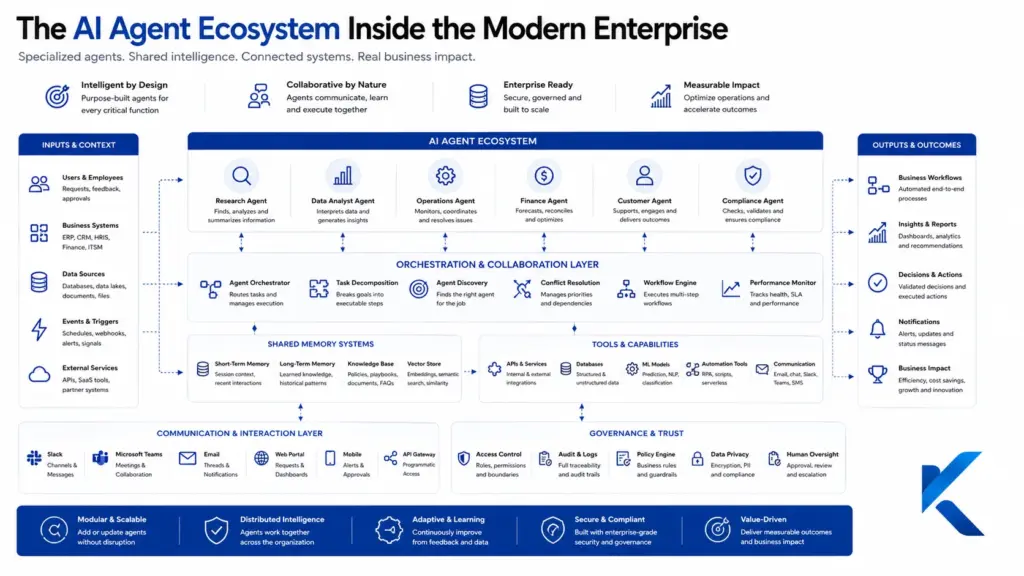
A shared knowledge and integration layer connects document repositories, databases, CRM platforms, ERP applications, ticketing systems, and specialized industry software. Retrieval-augmented generation, vector search, APIs, and conventional database queries should be used according to the type of information involved. Structured transaction data should generally be queried directly instead of being routed through semantic search without a business reason.
Identity management, authorization, audit logs, cost controls, testing, and monitoring form the operating layer. Without these capabilities, a multi-agent application may perform well in a demonstration but remain difficult to maintain. A production system must support transaction tracing, retries, intervention, rollback procedures, and manual takeover.
How do single agents, agent workflows, and multi-agent systems compare?
| Architecture | Typical design | Suitable work | Main advantages | Common limitations |
|---|---|---|---|---|
| Single AI agent | One agent with several tools | Knowledge retrieval, drafting, basic assistance | Lower implementation and operating effort | Tool and policy overload as the scope expands |
| Orchestrated agent workflow | Predetermined sequence of specialized agents | Quote preparation, document processing, ticket classification | Repeatable handoffs and testable process stages | Less adaptable when the required path changes frequently |
| Multi-agent ecosystem | Dynamic collaboration among several agents | Complex research, service operations, cross-functional workflows | Specialization, parallel execution, and modular expansion | Greater governance, monitoring, security, and recovery requirements |
Many mid-market use cases should begin with a bounded agent workflow. Dynamic delegation becomes worthwhile when the sequence of work cannot be determined reliably in advance. Anthropic likewise recommends introducing additional agentic complexity only when evaluation shows that it improves outcomes.
How does orchestration coordinate multiple AI agents?
Effective orchestration answers four operational questions for every stage: which component owns the task, what information it needs, what action it may perform, and how successful completion is determined. Critical operating rules should not exist only inside a long natural-language prompt. They belong in workflow logic, authorization controls, schemas, and executable validations.
Each agent should receive a defined input and return a structured output. Rather than producing unrestricted prose, an agent might return a JSON object containing status, evidence, source references, assessment, and a recommended next step. The orchestrator validates the object against a schema before starting another agent, requesting a correction, or transferring the case to an employee.
Reliable orchestration must also address duplicate execution. A purchasing, booking, payment, or CRM agent must not repeat an action simply because a network call was retried. Idempotent interfaces, transaction identifiers, status checks, and action locks reduce this risk.
For long-running work, state should be stored outside the language model’s context window. Persisted checkpoints allow an interrupted process to continue from a known stage. They also make it possible to rerun one failed task without repeating every previous action or paying for the entire conversation again.
Which responsibilities should specialized agents receive?
Agents should be defined by operational responsibility rather than by creative labels. In a technical services company, an intake agent might classify requests and identify missing information. A document agent may extract equipment data, specifications, images, and service history. A costing agent can prepare quantities, assumptions, and line items for commercial review.
A compliance agent may verify that required approvals and documentation are present. A communication agent can prepare a customer response based on validated findings. A separate execution agent can then transfer an approved change into a CRM, ERP, or ticketing platform.
This separation reduces the likelihood that one agent gathers facts, evaluates its own work, approves its recommendation, and performs an irreversible action. Payment instructions, contractual changes, employee data, personal information, and safety-related operations require distinct stages for analysis, recommendation, authorization, and execution.
A reviewer agent can add useful quality assurance, but it is not an independent technical control by itself. When the writer and reviewer use the same model, context, and assumptions, both may reproduce the same error. Sensitive processes therefore need rule-based checks, authoritative reference data, and human sampling in addition to model-based review.
How do a Company Brain, RAG, MCP, and A2A work together?
A Company Brain provides the ecosystem’s shared knowledge and context layer. It connects approved documents, process instructions, responsibilities, customer records, service history, and operational experience. Agents should not receive unrestricted access to the entire corporate knowledge base. They should receive only the context required for the current assignment.
Retrieval-augmented generation supplies relevant passages from documents and knowledge repositories. Structured records are often better served through APIs, SQL queries, or application-specific interfaces. A dependable architecture combines these methods and records which source contributed to an answer or recommendation.
The Model Context Protocol, commonly known as MCP, standardizes how agents connect to tools and data sources. The Agent-to-Agent protocol, or A2A, addresses communication and coordination between agents across different frameworks, vendors, and platforms. The Linux Foundation presents A2A and MCP as complementary building blocks for interoperable multi-agent environments.
Interoperability standards do not resolve process ownership or data governance. A technically compatible agent still needs an approved operating role, maintained interfaces, accountable data owners, and exception procedures. Standards can make components easier to replace, but they do not replace business architecture.
Where do AI agent ecosystems create practical mid-market value?
Quote preparation is a strong example in technical services. An intake agent reads the customer request and associates it with an account or project. A document agent identifies equipment models, photographs, specifications, and previous service records. A knowledge agent retrieves approved service modules, while a costing agent prepares line items and assumptions. A sales employee reviews the result before releasing the proposal.
In customer service, an agent team can classify a request, retrieve account information, search known solutions, and prepare an appointment option. The execution agent should not book the appointment until the customer or employee confirms it. This approach accelerates preparation without allowing an incorrectly interpreted request to create an immediate operational change.
In maintenance operations, one agent can evaluate readings and inspection records, another can retrieve applicable service instructions, and a third can prepare a work order. The technician receives a job-specific package based on the asset, location, service history, and access rights instead of a generic chat response.
Additional applications include invoice review, supplier communication, tender processing, internal IT, knowledge retention, and project documentation. The strongest candidates are processes in which employees repeatedly transfer information across systems, reconstruct context, and resolve the same missing-data questions.
What commonly goes wrong in multi-agent projects?
One recurring mistake is treating the number of agents as a sign of maturity. Teams create a separate agent for every small activity even when a conventional software function or deterministic rule would perform the work more reliably. Latency, model consumption, maintenance effort, and failure probability increase without improving the business result.
Unrestricted shared memory is another problem. When every agent can read every conversation, attachment, and intermediate conclusion, false or manipulated information can propagate throughout the ecosystem. Task-specific context, versioned artifacts, source metadata, and controlled handoff objects provide a safer operating model.
Some projects also lack ownership. After an incident, no one can identify which agent generated a statement, which model version was active, which source was retrieved, or which business rule was applied. Without an end-to-end audit trail, operators cannot investigate the case or demonstrate appropriate oversight.
Excessive write access is equally risky. An agent that researches, evaluates, approves, and executes changes crosses several trust boundaries. Gartner recommends treating autonomy and access scope as separate dimensions and applying controls in proportion to the agent’s actual ability to affect systems.
Finally, pilots are often evaluated through a small collection of impressive examples. Production readiness requires repeatable test cases, failure analysis, processing time, human rework, cost per case, and explicit stop conditions. A successful demonstration is evidence of potential, not evidence of dependable operations.
How should companies monitor agent performance and behavior?
Monitoring should cover the complete process, not only the final response. Relevant records include input sources, retrieved content, tool calls, agent handoffs, model versions, processing time, consumption, retries, failures, and executed actions. Sensitive content may need masking, segmentation, or separate retention policies.
Business owners and technical operators require different operational views. Process managers may track human rework, turnaround time, acceptance rates, and exception volumes. IT teams need interface errors, latency, availability, and resource consumption. Security and privacy teams need records of access, unusual actions, policy violations, and retention behavior.
Each agent and workflow should be tested against a maintained suite of representative cases. When a prompt, model, tool, integration, or knowledge source changes, regression testing can reveal whether performance improved or deteriorated.
Open-ended work cannot always be scored through a binary correct-or-incorrect measure. Evaluation may need to cover evidence, source use, role compliance, permitted tool behavior, completeness, and handoff quality. Human review remains important when the work involves judgment, incomplete information, or consequences that cannot be reversed easily.
Which security controls does an AI agent ecosystem require?
Each agent should have a distinct technical identity. Access should not be shared through a common administrator account. Bounded service identities, short-lived credentials, filtered APIs, and documented permissions limit the effect of a compromised component. An agent that summarizes records usually does not need permission to modify the source platform.
Tools should be exposed through a controlled execution layer. This layer validates parameters, target systems, user authority, and risk classification before allowing an action. Higher-risk operations may require approval, dual control, transaction limits, or a complete prohibition on autonomous execution.
Prompt injection, manipulated attachments, and compromised agents deserve particular attention. Malicious instructions embedded in a customer email or document must not automatically trigger a privileged tool action. OWASP notes that multi-agent environments introduce additional attack surfaces because compromised information and behavior can propagate across cooperating agents.
Network segmentation, secrets management, output validation, audit logging, and emergency shutdown mechanisms must therefore be designed alongside the workflow. Adding them after the agents have already received broad system access creates unnecessary rework and exposure.
How should governance and the EU AI Act influence the architecture?
An AI agent ecosystem should not automatically be treated as one uniform legal and operational unit. Applicable obligations depend on the use case, the company’s role, the data involved, and the risk profile of individual components. An internal document assistant differs materially from an agent that supports employment decisions or influences a safety-related process.
German companies should maintain an inventory of agent use cases, responsible owners, connected data sources, approved actions, and review procedures. Documentation should distinguish agents that observe, agents that recommend, and agents that perform changes.
The EU AI Act follows a phased application schedule. Requirements covering prohibited practices and AI literacy are already applicable, while additional transparency provisions become applicable on August 2, 2026. Each system must be assessed according to its actual purpose, deployment context, and role in the value chain.
The NIST AI Risk Management Framework provides a complementary methodology organized around Govern, Map, Measure, and Manage. It is not German law, but it can support risk identification, evaluation design, operational monitoring, and internal governance.
How can a mid-market company start without overengineering the solution?
The starting point should be a costly or burdensome process rather than a desired technology stack. A suitable workflow has recurring steps, accessible data, visible manual effort, and a business owner who can judge the results.
The existing process should first be documented, including handoffs, exceptions, approvals, system boundaries, and recurring sources of rework. The project team can then separate deterministic automation from steps that benefit from language understanding, retrieval, interpretation, or adaptive planning.
The initial implementation should remain bounded. Read access and preparatory work can be automated first, while write actions require confirmation. Tests should use representative, anonymized, or synthetic cases and include expected failures, missing documents, conflicting information, and unavailable systems.
A modular interface design supports later expansion. Agents should exchange defined objects rather than rely on hidden assumptions in conversation history. Every new component needs a business owner, an evaluation package, monitoring coverage, a permission review, and a documented fallback path.
When is an AI agent ecosystem the right investment?
An AI agent ecosystem becomes relevant when a workflow crosses several knowledge domains, applications, and decision points and a single general-purpose agent would require excessive authority or context. Processes involving high search effort, repeated handoffs, and manual verification are particularly promising.
Not every task needs a multi-agent architecture. A document summary, deterministic data transfer, or narrowly defined classification may be handled more economically by a single service or conventional workflow. Additional agents should be introduced only when specialization, parallel execution, independent review, or separate permission boundaries produce measurable value.
The objective is not maximum autonomy. Sustainable systems combine AI capabilities with established process logic, authoritative business data, technical safeguards, and accountable human decisions. This creates an automation foundation that can expand over time without sacrificing maintainability, operational control, or the ability to investigate failures.
Sources for the cited metrics
- Linux Foundation: “A2A Protocol Surpasses 150 Organizations, Lands in Major Cloud Platforms, and Sees Enterprise Production Use in First Year”
https://www.linuxfoundation.org/press/a2a-protocol-surpasses-150-organizations-lands-in-major-cloud-platforms-and-sees-enterprise-production-use-in-first-year - Capgemini Research Institute: “How generative AI and agentic AI redefine business operations”
https://www.capgemini.com/in-en/insights/research-library/ai-and-gen-ai-in-business-operations/ - McKinsey: “The State of AI: Global Survey 2025”
https://www.mckinsey.com/capabilities/quantumblack/our-insights/the-state-of-ai - Gartner: “Applying Uniform Governance Across AI Agents Will Lead to Enterprise AI Agent Failure”
https://www.gartner.com/en/newsroom/press-releases/2026-05-26-gartner-says-applying-uniform-governance-across-ai-agents-will-lead-to-enterprise-ai-agent-failure
Further reading
- Anthropic: Building effective AI agents and production architecture patterns
https://www.anthropic.com/engineering/building-effective-agents - National Institute of Standards and Technology: AI Risk Management Framework
https://www.nist.gov/itl/ai-risk-management-framework - OWASP: Multi-Agentic System Threat Modeling Guide
https://genai.owasp.org/resource/multi-agentic-system-threat-modeling-guide-v1-0/
What is an AI agent ecosystem?
An AI agent ecosystem is an architecture in which several specialized AI agents cooperate through defined interfaces. Each agent owns a bounded responsibility, uses approved data sources, and returns structured results. An orchestration layer assigns work, tracks process state, and determines when another agent or an employee must become involved.
How is a multi-agent system different from a single AI agent?
A single agent handles several activities with the same overall instructions, tools, and permissions. A multi-agent system distributes work across specialized roles. This enables more specific access controls, evaluation methods, and responsibilities. The tradeoff is greater effort for orchestration, handoffs, monitoring, error recovery, testing, and ongoing operations.
How many AI agents does a mid-market company need?
The appropriate number depends on the workflow rather than a general target. A small set of roles for intake, research, review, and execution is often sufficient. Another agent is justified only when it owns a distinct responsibility, requires different permissions or tools, or produces a measurable improvement through specialization.
Does every agent need a separate language model?
No. Several agents can use the same language model while differing in instructions, tools, permissions, and supplied context. Smaller or specialized models may be more economical for certain tasks. Model selection should consider output quality, privacy, latency, operating cost, deployment location, and the amount of context required.
Which data sources should AI agents be allowed to access?
An agent should access only the information required for its assigned task and permitted by the organization’s role model. Separate service identities, filtered APIs, and task-specific knowledge spaces can enforce these boundaries. Sensitive records may require additional logging, policy checks, data masking, and human approval before they are disclosed or processed.
How can several AI agents be monitored?
Monitoring should include tool calls, handoffs, model versions, processing time, consumption, retries, and executed actions in addition to final outputs. Every case should have an end-to-end transaction identifier. Operators can then locate the stage where a failure occurred, rerun a bounded step, and stop the process when unusual behavior appears.
Can errors become amplified across multiple agents?
Yes. A flawed intermediate result may be accepted as reliable by downstream agents and incorporated into further actions. Source metadata, structured handoff formats, independent validation rules, and limited context reduce this risk. An employee should confirm consequential results before an execution agent makes a difficult-to-reverse operational change.
What role should employees play in an agent ecosystem?
Employees define objectives, responsibilities, permissions, and escalation rules. They handle exceptions, review sensitive recommendations, and take over work when agents reach their operating limits. Human approval should be concentrated at high-risk decision points rather than blocking every automated step or granting unrestricted autonomy across the entire process.
How much effort does a multi-agent system require?
Effort is influenced more by data quality, integrations, permissions, and process variation than by the number of agents alone. A bounded workflow with maintained APIs may be implemented efficiently. Fragmented documents, undocumented systems, inconsistent master data, unresolved ownership, and numerous exceptions substantially increase engineering, testing, governance, and operating effort.
How should a company begin building AI agent ecosystems?
Start with a bounded process that has visible manual effort, an accountable business owner, and results that can be evaluated. Automate read access and preparatory tasks first while retaining confirmation for write actions. After representative testing, the company can add data sources, specialized agents, and additional authority in controlled stages.
