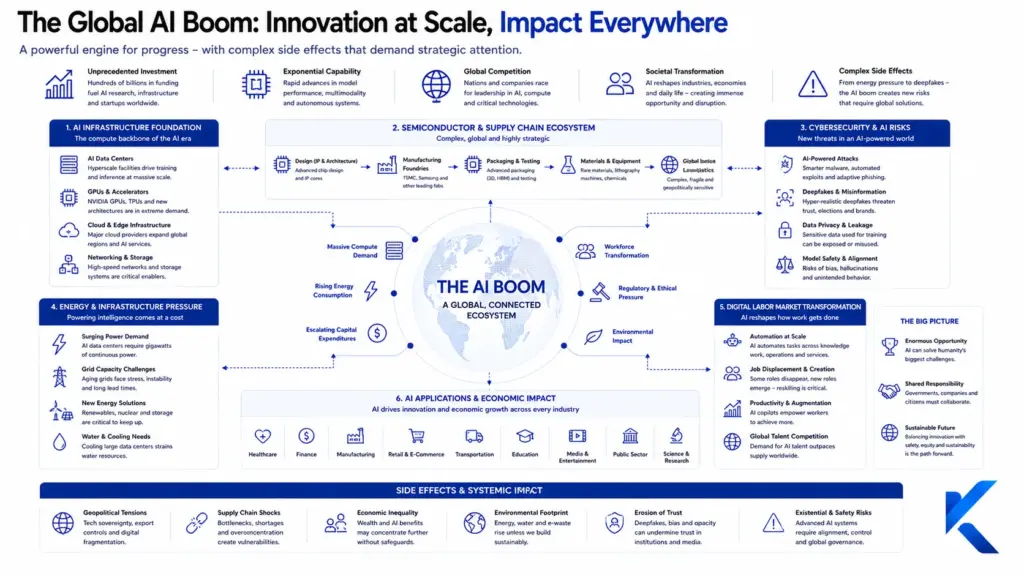
The risks of the AI boom now extend far beyond software, affecting chip supply, data centers, power infrastructure, cybersecurity, and workforce planning. AI-enabled attacks increase pressure on defenders while rapid adoption deepens operational dependencies. German mid-market companies therefore need to combine innovation with resilient architecture, controlled access, measurable economics, and targeted workforce development.
Why are the risks of the AI boom changing corporate planning?
Artificial intelligence is often treated as a software decision: select a model, create user accounts, and automate a process. That view misses the infrastructure behind every generated response. Modern AI depends on specialized semiconductors, data centers, electricity networks, cloud platforms, data pipelines, and globally distributed suppliers. At the same time, AI tools increase the speed at which attackers can research targets, test weaknesses, and produce convincing messages.
This creates a broader planning responsibility for German mid-market companies. Model quality and license pricing remain important, but they are no longer enough. Leadership teams also need to consider service availability, data location, identity management, portability, outage scenarios, and the tasks that must remain subject to human review. When a department introduces AI in isolation, risks frequently move into IT operations, procurement, privacy, or workforce management without being recognized early.
The strategic issue is not whether AI should be used. It is whether the company can continue operating when a provider changes a model, raises prices, restricts capacity, or experiences an outage. Resilience therefore becomes part of the value proposition rather than a separate compliance exercise.
Why is AI hardware becoming a strategic sourcing risk?
Semiconductor growth is no longer driven only by phones, vehicles, or industrial electronics. AI data centers require accelerators, high-bandwidth memory, advanced networking components, and specialized packaging capacity. The Semiconductor Industry Association reported that global chip sales grew by 25.6 percent in 2025. That pace illustrates how strongly AI investment now affects upstream production capacity.
Most mid-market companies will not purchase their own high-end accelerators. Their exposure appears through cloud instances, software-as-a-service products, model APIs, and managed data center services. Supply constraints can therefore surface as higher prices, limited regional availability, longer provisioning times, lower service tiers, or changing contract terms. The risk becomes material when a business process depends on provider-specific functions that cannot be replaced without redesigning the workflow.
A common implementation mistake is to build the first successful use case directly around proprietary platform features. Consider an AI-assisted quoting process that relies on one vendor’s orchestration, storage, and model interface. If pricing changes or a required region becomes unavailable, the company has little negotiating power. Abstracted interfaces, exportable data, documented prompts, and portable process logic reduce that dependency without requiring a complex multi-cloud environment.
Why is AI placing more pressure on power infrastructure?
Training and running modern AI systems requires computing power, cooling, and grid capacity. A current Lawrence Berkeley National Laboratory study estimates that data centers could account for approximately 11.8 percent of total US electricity consumption by 2030. The estimate cannot be transferred directly to Germany, but it demonstrates the potential scale of the infrastructure shift.
This does not mean every AI application has an excessive energy footprint. A focused assistant for document retrieval has a different profile from training a foundation model. The relevant variables are model size, workload volume, context length, data movement, utilization, and the efficiency of the hosting environment. In many use cases, cost and resource consumption improve together when companies use smaller models, caching, targeted retrieval, and workload limits.
Projects often fail economically because decision-makers compare only per-user license fees. Variable API consumption, repeated retrieval, observability, security scans, test environments, and backup processing appear later. A reliable business case should include ongoing compute demand, integration work, monitoring, continuity measures, and switching costs. FinOps practices for AI should therefore begin during the pilot rather than after broad rollout.
How is AI changing the cyber threat to businesses?
AI does not create an entirely new category of cybercrime. It makes established tactics faster, cheaper, and easier to scale. The United Kingdom’s National Cyber Security Centre assesses that AI will make parts of intrusion operations more effective and efficient, increasing the frequency and intensity of cyber threats. Relevant areas include reconnaissance, vulnerability research, social engineering, malware adaptation, and analysis of stolen data.
Connected AI systems also create additional attack paths. Model endpoints, plugins, retrieval pipelines, credentials, external tools, and agent permissions can expose business systems in new ways. Prompt injection is not only a content-quality issue when an agent can send email, update a customer record, or retrieve confidential files. The same natural-language interface that makes a system easy to use can become a control surface for an attacker.
For mid-market companies, identity matters more than prompt wording. A summarization tool with read-only access presents a different risk than an agent connected to CRM, email, file storage, and ERP. Permissions, approval gates, logging, segmentation, and incident response should reflect the business impact of each action. A conversational interface should never receive broad technical authority merely because it appears helpful.
Documented incidents are also increasing. The Stanford AI Index recorded 362 documented AI incidents in 2025. Such databases do not capture every event, but they demonstrate that misuse, unsafe behavior, discriminatory outcomes, security failures, and weak oversight become more visible as deployment expands.
Why is the labor market issue more complex than job loss?
The International Labour Organization estimates that roughly one in four workers worldwide is employed in an occupation with some exposure to generative AI. The research also concludes that task transformation is more likely than complete occupational replacement.
For German mid-market firms, this is an operating model issue. In procurement, sales, field service, engineering, administration, and project management, the balance between research, drafting, verification, and documentation is changing. Employees need to evaluate output, recognize exceptions, validate sources, and remain accountable for consequential decisions. The talent bottleneck therefore extends beyond data scientists to domain experts who can supervise AI-supported work.
Experience from implementation projects shows a recurring pattern. Companies buy tools before they define roles, learning objectives, and quality expectations. Adoption becomes uneven: advanced users create private workflows, other employees avoid the system, and some accept outputs without sufficient review. Training works better when it is tied to real tasks, quality thresholds, escalation routes, and the decisions employees are authorized to make.
Research on European firms also indicates that complementary investments in software, data, and workforce training are important for realizing productivity gains. Technology adoption without those foundations can shift work rather than improve it.
Which risk areas should mid-market companies compare?
| Risk area | Typical trigger | Common failure pattern | Practical control |
|---|---|---|---|
| Semiconductors and cloud capacity | Rapid growth in demand for AI computing | Full dependence on a single provider | Portable interfaces, data export, and an exit plan |
| Energy and operating cost | High usage volumes and oversized models | Budgeting only for license fees | Meter consumption, right-size models, and cap workloads |
| Cybersecurity | Agents receive access to production systems | Excessive permissions and missing logs | Least privilege, approvals, logging, and recurring tests |
| Workforce design | Tasks change faster than roles | Employees receive tools without operating guidance | Process-based training, review criteria, and ownership |
| Governance | Departments adopt tools independently | Shadow AI and uncontrolled data movement | Approved tool catalog and a defined intake process |
These categories are interconnected. A provider change becomes more than a procurement issue when data formats, permissions, and daily workflows depend on the platform. A capable agent becomes more than a productivity tool when it can access customer data or operational systems. Decisions therefore need input from IT, business owners, procurement, cybersecurity, privacy, and executive leadership.
What usually goes wrong in real-world AI projects?
The first recurring mistake is confusing a demonstration with production readiness. A demo shows that a model can perform a task under favorable conditions. It says little about malformed input, outdated documents, access conflicts, peak load, model updates, or provider outages. Without representative test cases from everyday operations, performance remains unpredictable.
The second mistake is selecting an initial use case that is too broad. An agent that reads email, drafts quotes, changes customer data, and books appointments creates too many failure paths at once. A better starting point is a bounded process with approved data, a measurable outcome, and a defined human review. Additional authority should be added only after failure modes, cost behavior, and ownership are understood.
The third mistake is failing to inventory existing use. Many organizations do not know which AI services are already used through browser extensions, mobile applications, office features, or personal accounts. That creates inconsistent handling of business data even before an official project starts. A practical system register, combined with a usable approved alternative, often produces more value than a lengthy strategy document.
A fourth mistake is treating security as a launch gate rather than an operating discipline. Models, connectors, data sources, and threat patterns change after deployment. Controls therefore need periodic testing, access reviews, incident procedures, and a process for retiring systems that no longer meet business requirements.
What does a resilient mid-market use case look like?
A technical services company wants to improve preparation for maintenance visits. Instead of giving an autonomous agent write access to the ERP system, the company begins with a read-only assistant. It can retrieve approved manuals, service histories, and internal work instructions, summarize relevant information, and identify the source documents. A service technician decides which information should be added to the work order.
The company then reviews recurring questions, missing documents, incorrect matches, and user feedback. Only after those patterns are understood does the system receive another capability, such as drafting a service report. Actions that modify production records remain subject to approval. This approach may appear less ambitious than immediate autonomy, but it usually reaches stable operations faster because each expansion is based on observed performance.
The design also aligns with the lifecycle approach in the NIST Generative AI Risk Management Profile. Risk is considered during selection, development, deployment, use, monitoring, and retirement rather than being assessed only before launch.
How can companies combine technological progress with responsibility?
Responsible AI adoption does not require slowing every initiative. It requires connecting implementation speed with operational resilience. Mid-market organizations do not need an oversized governance department, but they do need a repeatable process for selecting, approving, operating, monitoring, and retiring AI systems.
For companies operating across Germany and the United States, vendor policies and contractual terms may also differ by region. A global platform can offer separate hosting, support, and data-use conditions, so procurement should verify the exact service configuration rather than relying on a general product description. Regional portability should be tested before a process becomes business-critical.
The most effective measures are often straightforward: restrict data sources, minimize permissions, prepare for provider changes, measure consumption, retain human review for consequential actions, and train employees in the workflow they actually perform. These controls make it easier to adopt new models because the surrounding architecture remains stable.
The winners of the AI boom will not be determined by model quality alone. Companies that understand dependencies, include infrastructure and cybersecurity in investment decisions, and prepare their workforce for changing responsibilities will be better positioned to capture value. That combination turns responsible adoption into a durable operating capability rather than a temporary technology project. Innovation remains possible without giving up confidentiality, continuity, or economic control.
Sources for the cited statistics
Semiconductor Industry Association: Global semiconductor sales growth in 2025
https://www.semiconductors.org/global-annual-semiconductor-sales-increase-25-6-to-791-7-billion-in-2025/
Lawrence Berkeley National Laboratory: US data center electricity use through 2030
https://eta.lbl.gov/publications/united-states-data-center-energy-2025
Stanford HAI: Documented AI incidents in the 2026 AI Index
https://hai.stanford.edu/ai-index/2026-ai-index-report/responsible-ai
International Labour Organization: Generative AI and occupational exposure
https://www.ilo.org/publications/generative-ai-and-jobs-refined-global-index-occupational-exposure
Further reading
UK NCSC: Impact of AI on the cyber threat from now to 2027
https://www.ncsc.gov.uk/report/impact-ai-cyber-threat-now-2027
NIST: Artificial Intelligence Risk Management Framework Generative AI Profile
https://www.nist.gov/publications/artificial-intelligence-risk-management-framework-generative-artificial-intelligence
Bank for International Settlements: AI adoption, productivity, and employment in European firms
https://www.bis.org/publ/work1325.htm
Is the AI boom primarily an opportunity or a risk for mid-market companies?
It is both. AI can accelerate research, documentation, service delivery, and decision support. It also creates new dependencies on vendors, data access, and computing infrastructure. Business value therefore depends less on the tool alone than on process selection, permissions, data quality, cost controls, and the organization’s ability to review outputs with appropriate domain expertise.
What supply chain risks are created by AI hardware demand?
Most mid-market firms do not buy high-end accelerators directly, but they are exposed through cloud services and software vendors. Constraints affecting chips, memory, networking, packaging, or data center capacity can change price, availability, and contract terms. Companies should maintain exportable data, documented interfaces, and a credible path for continuing critical processes with another provider.
Should companies avoid AI because of electricity consumption?
No. Resource demand depends on the model, workload, architecture, and hosting environment. Many business tasks do not require a large foundation model or custom training. Smaller models, limited context, caching, and targeted retrieval can lower both cost and consumption. Energy should be evaluated as part of architecture and sourcing rather than used as a universal reason to reject AI.
How does AI change phishing and social engineering?
AI makes it easier to produce convincing messages, translations, call scripts, and personalized fraud attempts. Attackers can process public information faster and generate many variations. Technical filtering remains important but cannot carry the full burden. Payment changes, new bank details, credential requests, and unusual access requests should be verified through a second, independent communication channel.
Are locally hosted AI systems automatically safer?
No. Local hosting can reduce external data flows and increase infrastructure control, but it does not eliminate weak configuration, excessive permissions, vulnerable interfaces, or poor data handling. Local models still require patching, logging, access controls, dependency management, and incident procedures. Security depends on the full architecture and operating model, not simply on where the model runs.
What role does shadow AI play inside a company?
Shadow AI appears when employees use unapproved tools through personal accounts, browser extensions, or mobile applications. It often results from time pressure rather than malicious intent. A prohibition alone rarely changes behavior. Companies need practical approved options, understandable usage rules, training, and a responsive process for evaluating new tools that employees believe could improve their work.
Will AI eliminate jobs in mid-market companies?
Some tasks will disappear or change substantially, but entire occupations are not automatically removed. Work often shifts from creation toward review, supervision, exception handling, and customer interaction. Companies should examine affected task components, identify future skills, and help employees transition into changed roles. Workforce planning should focus on job design and capability development rather than headcount alone.
Which skills become more important during the AI boom?
Process knowledge, domain judgment, data literacy, cybersecurity awareness, and the ability to evaluate automated output become more valuable. Most employees do not need to build models. They need to provide useful inputs, identify errors, assess sources, and retain accountability for important decisions. Training should be connected to real workflows, measurable quality expectations, and defined escalation paths.
How should a company evaluate AI vendors?
Evaluation should cover data processing, subcontractors, hosting locations, identity controls, logging, availability, portability, and exit options in addition to features and price. Companies should also consider how quickly models or functions may change. A provider is suitable when its service can fit the company’s architecture and risk category, not simply when the demonstration is impressive.
What are the best first steps for a mid-market company?
Begin by inventorying existing AI use, identifying sensitive processes, and selecting a bounded use case. Establish approved data sources, minimum permissions, human review, and ongoing measurement of cost and quality. In parallel, create a lightweight intake process for new tools. This gives business teams a practical route to adoption without pushing them toward unofficial services.
