
Relational databases such as PostgreSQL remain essential for structured, reliable and traceable business processes, while graph databases improve the understanding of relationships between connected data. Vector databases add semantic understanding by enabling systems to retrieve information based on meaning rather than exact matches. Combined together, these technologies form modern “second brain” architectures that transform data from passive storage into operational knowledge that actively supports workflows and decision-making.
The way companies think about databases has changed significantly in recent years. It is no longer just about storing data reliably. The real challenge today is making information usable in day-to-day operations. This is where the differences between structured databases, graph databases, and semantic vector databases become relevant.
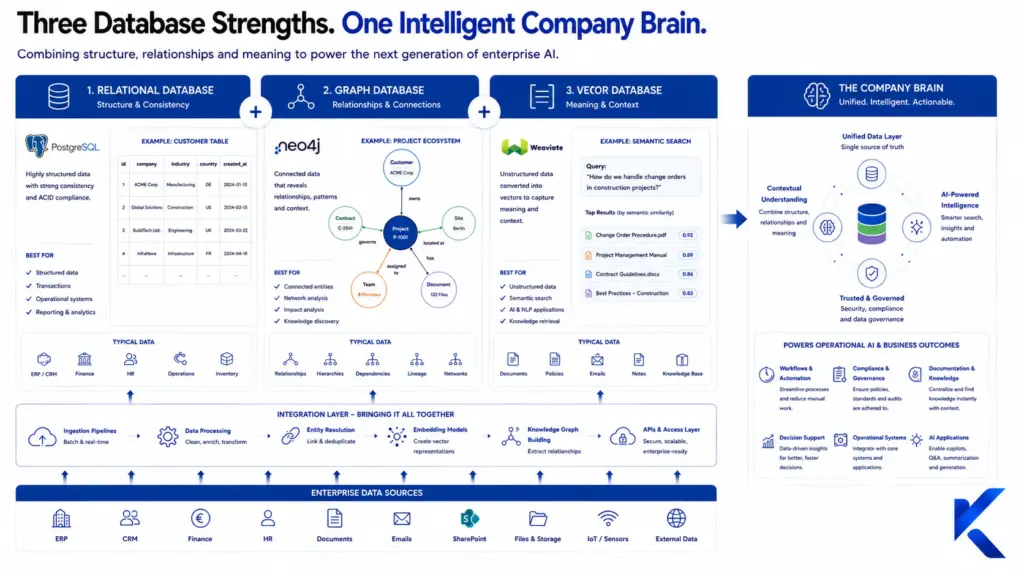
Traditional systems like PostgreSQL remain the backbone of many applications. They are stable, predictable, and well understood. Structured databases organize data into tables with defined relationships, making them ideal for processes that require clarity and consistency. When companies manage operations such as documentation, offers, or compliance checks, precision is critical. Every entry must be traceable, every result reproducible. This is where relational systems excel.
Bring AI into daily operations in a structured way
The KrambergAI AI Introduction helps companies select suitable use cases, prepare workflows and integrate AI solutions into everyday operations in a controlled and practical way.
Structured implementation · Practical guidance · Made in Germany
However, limitations become apparent when dealing with complex relationships that cannot easily be modeled in tables. Graph databases address this by focusing on connections instead of structure alone. They represent data as nodes and relationships, making it easier to understand how elements interact. In environments with complex dependencies or regulatory requirements, this approach provides a clearer view of how decisions and processes are linked.
Still, graph databases do not fully solve the problem of understanding meaning. They remain structured systems. What they lack is semantic interpretation. This is where vector databases come into play, especially when combined with technologies like pgvector in PostgreSQL.
Vector databases represent information as mathematical embeddings rather than fixed values. This allows systems to identify similarity instead of exact matches. In practical terms, users no longer need to search for the exact phrase. The system understands context and retrieves relevant information based on meaning.
This capability becomes particularly valuable in systems designed as a “second brain.” Instead of forcing employees to remember exact data points, the system provides relevant knowledge when needed. While a traditional database asks, “What exactly is stored?”, a vector database asks, “What does this mean?”
The real advantage emerges when these technologies are combined. Modern architectures often integrate structured storage with semantic retrieval. PostgreSQL remains the foundation, enhanced with vector indexing. This hybrid approach delivers both reliability and flexibility. Structured data ensures consistency, while semantic layers add context.
This shift reflects a broader trend. Companies are moving away from simple data storage toward systems that actively support workflows. Offers are no longer just saved; they are evaluated. Documentation is not just stored; it becomes accessible and usable. Decisions are no longer based on raw data alone but on contextual understanding.
It is important to position these technologies correctly. PostgreSQL is not being replaced—it remains essential. Graph databases provide insight into relationships. Vector databases add semantic understanding. Together, they form a system capable of supporting real operational work.
For software that aims to simplify complex processes, this combination is becoming standard. Especially in industries with regulatory complexity, where knowledge, rules, and workflows intersect, these technologies create a measurable advantage. Systems become faster, more reliable, and easier to use.
Ultimately, the question is not which database is better. The question is what role each one plays. Structured databases provide order. Graph databases reveal relationships. Vector databases provide meaning. Combined, they enable a new generation of systems—systems that do not just store data, but actively make work easier.
Further reading
- PostgreSQL – Official Documentation
https://www.postgresql.org/docs/ - Neo4j – Introduction to Graph Databases
https://neo4j.com/developer/graph-database/ - pgvector – Open Source Vector Similarity Search for PostgreSQL
https://github.com/pgvector/pgvector
FAQ
Why are relational databases still important?
Relational databases provide structured, reliable and traceable storage for operational business processes and compliance-critical systems.
What is the main advantage of graph databases?
Graph databases specialize in representing relationships and dependencies between connected entities.
What do vector databases add to modern systems?
Vector databases enable semantic search and contextual retrieval based on meaning rather than exact keywords.
Why combine PostgreSQL, graph databases and vector search?
The combination creates systems that offer structure, relationship awareness and semantic understanding simultaneously.
