
AI agent security architecture must protect more than servers, networks, and application code; it must also constrain goals, decisions, memory, tools, and delegated actions. Traditional cybersecurity controls remain essential, but they do not govern probabilistic behavior by themselves. Secure deployments require distinct identities, least-privilege access, controlled tool interfaces, runtime monitoring, data integrity, and approval gates for consequential actions.
Why are traditional security models insufficient for AI agents?
Traditional application security is built around software that executes predefined functions. A user submits a form, the application validates the fields, calls a known service, applies programmed business logic, and returns a result. Security teams can map expected paths, test functions, inspect code, and enforce access at relatively stable boundaries.
An AI agent operates differently. It receives an objective, interprets available context, develops intermediate steps, and selects tools based on the situation. Even when two tasks appear almost identical, the agent may choose different sources, sequence its actions differently, or generate a different plan.
Bring AI into daily operations in a structured way
The KrambergAI AI Introduction helps companies select suitable use cases, prepare workflows and integrate AI solutions into everyday operations in a controlled and practical way.
Structured implementation · Practical guidance · Made in Germany
This changes what the organization must protect. Infrastructure, applications, APIs, and databases remain in scope, but they are only part of the system. The agent’s objective, working context, identity, memory, tool catalog, delegated authority, and action history also become security-relevant assets.
The current agentic security framework from the OWASP Foundation (https://owasp.org/) identifies risks such as goal hijacking, tool misuse, identity and privilege abuse, memory poisoning, insecure agent-to-agent communication, cascading failures, human trust exploitation, and rogue behavior. These risks arise from the interaction between models, orchestration layers, identities, data, integrations, and business processes rather than from the language model alone.
A firewall cannot determine whether an agent’s new intermediate goal still serves the user’s original request. An identity provider cannot decide whether a technically permitted CRM export is appropriate for the current case. An API gateway may authenticate the request while remaining unaware that untrusted content redirected the agent’s planning.
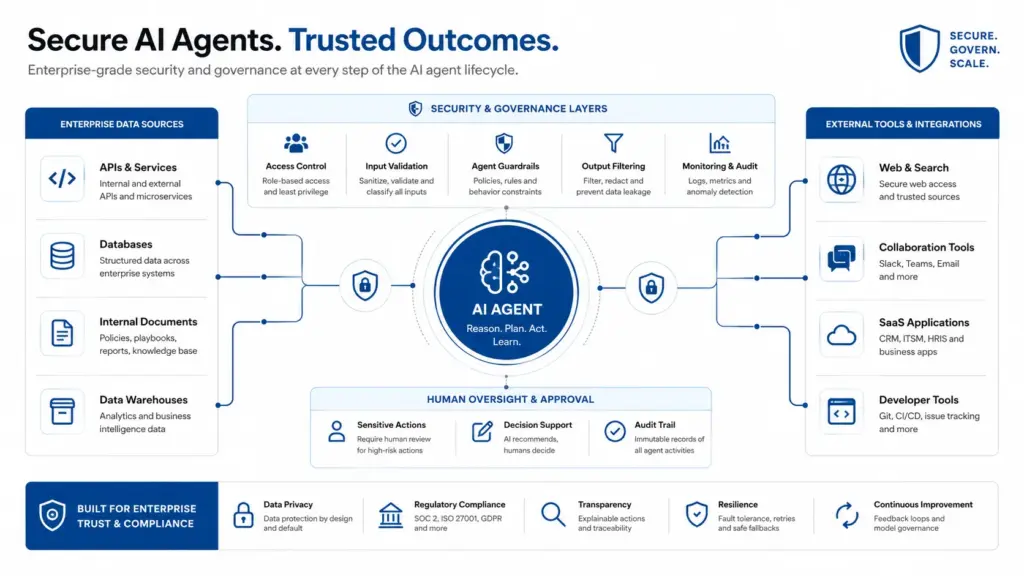
Agent security therefore adds a behavioral control plane on top of established cybersecurity. The architecture must evaluate not only who can access a service, but also why the service is being called, which information influenced the decision, what the agent intends to do next, and how much damage an incorrect action could cause.
How is an AI agent different from a conventional chatbot?
A basic chatbot produces text. An agent can change the state of business systems. It may create a CRM record, retrieve customer documents, update a work order, schedule an appointment, prepare a purchase request, send a message, execute code, or trigger another automated service.
The security difference lies in operational reach. A poor chatbot response may confuse an employee. A poor agent decision can alter master data, disclose confidential information, create a binding commitment, interrupt production, or launch a chain of downstream actions.
Agents also consume material whose trust status may vary. Their context can include email, PDFs, support tickets, web pages, source code, project documents, database records, and outputs from other agents. An attacker can place instructions inside those materials. To the model, both legitimate business content and malicious instructions arrive as tokens unless the surrounding architecture establishes and enforces different trust levels.
A secure system must therefore separate information from authority. A supplier document may provide an item number or delivery date, but it should not be able to redefine the agent’s system policy. An email may describe a requested change, but it should not independently authorize access to additional customer records.
This separation is difficult to achieve with prompt wording alone. It requires architectural enforcement through scoped identities, tool restrictions, data labels, policy decisions, approval gates, and runtime controls.
Which new attack surfaces emerge from planning and autonomy?
Agentic systems create intermediate goals while working. A service agent might first locate the customer, then inspect equipment history, review a manual, draft troubleshooting steps, and prepare a follow-up message. If the context is manipulated during this process, the entire remaining plan may change.
Goal hijacking occurs when malicious or misleading content diverts the agent from the authorized objective. A hidden instruction in a document could ask the agent to retrieve unrelated data. A compromised web page could influence which tool it selects. A manipulated tool description could convince the agent that an unsafe function is necessary.
Autonomy also introduces compounding effects. A single action may create input for another agent, update shared memory, modify a task queue, or trigger an external workflow. A local error can therefore propagate into multiple systems before a human sees the outcome.
Multi-agent designs increase this challenge. A coordinator delegates work to specialized agents, each with different tools and privileges. The coordinator may treat returned content as trusted, even though a worker agent processed an untrusted source or encountered a compromised integration.
The architecture must place limits around planning depth, delegation, retries, tool selection, data volume, cost, and elapsed time. It should also define which intermediate goals are acceptable and which require escalation.
Why is agent identity a foundational architecture decision?
Many early agent deployments run under a user’s identity or a broadly authorized service account. This approach is convenient because existing APIs already accept those credentials. It also creates an attribution and privilege problem.
A proposal agent may need read access to customer requirements, approved price lists, product documentation, and previous estimates. It does not automatically need access to payroll, administrative settings, all customer exports, or every shared drive.
When the agent inherits the full authority of the user who launched it, a narrow task gains a broad blast radius. If a malicious document changes the agent’s plan, the inherited permissions determine how far the compromise can go.
Research published by IBM (https://www.ibm.com/) illustrates the access-control gap. Thirteen percent of surveyed organizations reported compromised AI models or applications. Among affected organizations, 97 percent reported that appropriate AI access controls were not in place.
A production agent should therefore have its own workload identity. That identity must have an accountable owner, documented purpose, defined data scope, and restricted tool access. The authorization decision can still include the initiating user, but the agent should not simply inherit every permission assigned to that user.
Distinct identities also improve incident response. Security teams can revoke one agent’s tokens, isolate its workload, inspect its actions, and preserve other business services. Without a separate identity, agent activity can become indistinguishable from normal employee activity.
How should least-privilege access work for an AI agent?
Least privilege for agents should be task-specific, short-lived, and action-aware. Traditional service accounts often retain standing access for months or years. Agents are better served by credentials issued for a particular task and revoked or expired when that task ends.
A service agent could receive temporary permission to read one customer case, retrieve documentation for one asset, and store a draft note. It would not receive unrestricted access to every account in the CRM or the ability to change billing details.
Permissions should distinguish between reading, proposing, creating, editing, sending, approving, and deleting. An agent may draft an email without being allowed to send it. It may prepare a purchase order without approving the expenditure. It may suggest a role change without modifying the identity platform.
Data boundaries should be equally specific. A field-service agent can use manuals, service histories, parts catalogs, and approved troubleshooting procedures while remaining unable to access employee records, executive files, or confidential acquisition materials.
Authorization also needs business context. The policy engine should evaluate the initiating user, agent identity, purpose, customer or project scope, data classification, selected tool, proposed parameters, and potential consequence. A technically valid request can still be inappropriate for the current assignment.
Why are tools and external integrations a major source of risk?
Agents become useful when they can reach business systems. Common integrations include CRM, ERP, document management, email, calendars, ticketing, cloud storage, databases, search services, development tools, and industry-specific platforms.
Every integration expands the set of actions that an agent can attempt. It also adds another software supplier, credential, schema, network path, update cycle, and potential failure mode.
Verizon’s 2026 Data Breach Investigations Report (https://www.verizon.com/) found third-party involvement in 48 percent of analyzed breaches. This is especially relevant to agentic systems because model providers, tool servers, plug-ins, APIs, data sources, and orchestration components can all participate in one automated workflow.
Connecting every agent directly to every target system makes governance and incident containment difficult. A controlled mediation layer is a stronger design. A tool gateway or policy enforcement point can authenticate the agent, evaluate the requested action, validate parameters, filter sensitive content, enforce rate limits, and create a structured audit event.
This gateway must evaluate usage, not merely availability. An email tool might be permitted for internal drafts while external recipients, attachments, or large distribution lists require additional review. A database tool might support a parameterized customer lookup but reject unrestricted queries or bulk exports.
How does the Model Context Protocol affect agent security?
The Model Context Protocol, commonly called MCP, provides a standardized way to connect AI applications with tools and data sources. It can accelerate integration with files, databases, developer environments, search services, and line-of-business applications.
MCP also creates a new trust boundary. A server can advertise tools, descriptions, schemas, prompts, and resources that enter the agent’s runtime context. The agent may rely on those descriptions when deciding what a tool does and whether it is appropriate for the task.
A compromised or poorly governed MCP server can expose excessive functionality, misuse inherited credentials, return manipulated content, or change its behavior after initial review. Tool descriptions themselves can become part of the attack surface if they influence planning.
Organizations should manage MCP servers as production integration components. Each server needs an owner, approved purpose, software inventory, version controls, restricted network placement, scoped secrets, update procedures, and monitored outbound connections.
Dynamic discovery should not equal automatic authorization. A newly visible tool should remain unavailable until it has been reviewed and mapped to a policy. Changes to schemas, descriptions, permissions, or endpoints should trigger reassessment.
The agent should also be prevented from installing, configuring, or enabling new MCP servers on its own unless that capability is explicitly required and subject to a separate approval path.
How can memory and context be protected from poisoning?
Agents frequently use multiple forms of memory. Short-term memory contains the current conversation and intermediate results. Long-term memory may store preferences, prior decisions, summaries, or recurring instructions. Retrieval systems provide documents from vector databases, knowledge repositories, file stores, and relational systems.
These sources affect future planning. A poisoned memory entry is therefore more than inaccurate data. It can become a persistent behavioral influence that survives across sessions and tasks.
The OWASP Foundation (https://owasp.org/) treats memory and context poisoning as a dedicated agentic risk. A single malicious contribution can remain available and continue shaping later tool choices or decisions.
Memory entries need provenance. The system should record the origin, creator, creation time, approval status, scope, expiration, and intended use of stored information. Content derived from an external website should not receive the same trust status as an approved company procedure.
Different memory classes should be separated. User preferences, temporary working notes, verified organizational knowledge, system policy, and security configuration should not share one undifferentiated store. The agent should never be able to overwrite high-trust policy merely by saving a new summary.
Organizations also need retention rules. Temporary credentials, confidential intermediate results, and personal data should be removed or archived according to defined schedules. Persistent memory should not become an unlimited repository of every prompt, document, and model output.
Integrity checks, version history, approval workflows, and rollback mechanisms can help detect and remove corrupted state before it influences additional tasks.
Why does conventional logging fall short for agentic systems?
A traditional application log may record the endpoint, user, timestamp, status code, and error message. For an agent, the security-relevant story connects the objective, context, policy decisions, tool sequence, and final action.
An investigation should be able to determine who initiated the task, which agent identity was used, what objective was supplied, which data sources contributed, what tools were available, which tool calls were attempted, what policies allowed or blocked them, and which human approvals were obtained.
Memory changes also require auditability. If a stored summary influenced a later decision, investigators need its provenance and version history. In multi-agent systems, delegation and message exchange must be traceable across components.
At the same time, logging every prompt, document, and response without filtering creates another sensitive repository. Credentials, customer records, intellectual property, and personal information may end up in monitoring systems that have broader access than the original application.
A more sustainable design uses structured metadata, references, hashes, classifications, and protected detail stores. Security teams receive sufficient evidence without replicating all business content in every observability platform.
Agent observability must also detect behavior patterns. A proposal assistant that suddenly queries many unrelated accounts, contacts a new external domain, or repeatedly invokes a blocked tool should be stopped or escalated even if each individual request is technically well formed.
How do traditional application security and agent security compare?
| Security area | Traditional application | AI agent |
|---|---|---|
| Execution model | Mostly predefined program flow | Context-dependent planning and tool selection |
| Identity | User account or standing service account | Distinct workload identity with task-scoped authority |
| Inputs | Forms, files, and API parameters | Also natural language, external documents, memory, and agent outputs |
| Authorization | Commonly enforced at the API or function | Enforced before planning steps, tool use, and consequential actions |
| Logging | Request, user, response, and error | Also objective, provenance, tool chain, policy decision, and approval |
| Testing | Functional, vulnerability, and penetration testing | Also adversarial prompts, context poisoning, behavioral and delegation tests |
| Failure impact | Often limited to one function or service | Can propagate across tools, systems, agents, and workflows |
| Containment | Disable an account, application, or endpoint | Revoke tokens, stop tasks, block tools, isolate memory, and halt delegation |
Traditional controls remain the foundation. Network segmentation, patch management, encryption, secure software development, backups, endpoint protection, vulnerability management, and incident response are still required.
Agent security adds controls for intent, runtime behavior, data provenance, delegated authority, memory, and cross-system actions. The two disciplines are complementary rather than competing approaches.
What does a layered AI agent security architecture look like?
The first layer is the underlying computing environment. Models, orchestration services, vector stores, tool servers, gateways, databases, and runtime environments require patching, hardening, segmentation, encryption, secrets management, backups, and standard workload monitoring.
The second layer is identity. Every agent needs a distinct identity, accountable owner, defined purpose, and constrained role. Short-lived credentials reduce the value of stolen tokens and limit persistent access.
The third layer governs data. Sources receive classification, provenance, permitted-use labels, and retention rules. Sensitive information can be filtered, tokenized, masked, or kept within a controlled environment before content reaches an external model.
The fourth layer controls tools. API calls, MCP requests, code execution, database queries, messages, and system changes pass through an enforcement point. Parameters, destinations, data volume, risk class, and approval status are checked before execution.
The fifth layer monitors behavior. The system detects unexpected goal changes, unusual tool sequences, repeated failures, excessive retries, abnormal data retrieval, and departures from the authorized workflow. Limits on runtime, cost, tool calls, delegation depth, and data volume constrain runaway processes.
The sixth layer handles human authority. Consequential actions are presented for review with the proposed change, target system, data used, expected effect, and relevant difference from the prior state.
The final layer covers operations. The organization defines ownership, incident procedures, test schedules, change management, emergency shutdown, recovery, and reporting.
The National Institute of Standards and Technology, NIST (https://www.nist.gov/), is developing implementation-focused control overlays that explicitly address single-agent and multi-agent systems. This reflects the need to adapt established security controls to distinct AI components and usage patterns rather than replacing the entire security program.
When should a human approve an agent action?
Not every action requires approval. Low-impact tasks such as retrieving approved documents, summarizing internal material, or preparing a nonbinding draft can often run automatically within restricted boundaries.
Approval becomes important when an action is difficult to reverse, affects an external party, changes authority, moves money, deletes data, alters a contract, publishes content, or affects physical operations.
Examples include payments, purchase orders, contract acceptance, account provisioning, role changes, external email, customer commitments, public releases, data deletion, and modifications to production or operational technology.
Approval should not consist of a generic button with insufficient context. The reviewer needs to see the proposed action, affected record, destination, supporting data, relevant risk, and expected outcome. Material differences from previous versions should be highlighted.
The approval token should be bound to the specific action. An authorization to send one reviewed message should not permit the agent to modify the content, change the recipient, attach another document, and reuse the approval later.
Approval and execution should also be separated technically. The agent must not be able to manufacture, modify, or bypass the evidence required for authorization.
Which use cases provide a safer starting point for midmarket firms?
Strong early use cases combine high information volume with limited authority. A service agent can structure incoming requests, locate relevant manuals, summarize equipment history, and prepare a case for the service desk. An employee remains responsible for the customer response or work authorization.
A proposal agent can extract requirements, locate prior estimates, identify missing information, and prepare a draft package. Pricing overrides, discount approval, contractual commitments, and external submission remain protected.
A document agent can classify files, suggest metadata, detect duplicates, and route material to a review queue. It should not autonomously delete records, alter retention periods, or release confidential files.
A procurement assistant can compare approved supplier data, summarize quotations, and prepare a purchase request. It should not change vendor banking details or release a payment.
Risk increases rapidly when one agent receives broad access to email, ERP, file storage, code execution, customer databases, and public communication at the same time. Midmarket firms should expand authority only after monitoring, identity, testing, and exception handling have demonstrated reliable performance.
What commonly fails during agent security projects?
A recurring mistake is focusing primarily on model selection and prompt filters. The team compares models and refusal behavior while the agent uses an overprivileged service account. In that design, technical reach creates more risk than response quality.
Another problem is treating the security review as a one-time launch activity. Agents change when teams add tools, replace models, connect data sources, modify memory, or allow delegation. Each extension can produce new action paths and new combinations of privilege.
Agent inventories are often incomplete. Security and IT teams may not know which agents are running inside SaaS platforms, departmental automation, developer tools, or experimental workflows. Without an inventory, the organization cannot review ownership, access, data flow, or incident exposure.
Logging can also be implemented without data discipline. Entire conversations, uploaded documents, credentials, and generated outputs are copied into central observability systems. The monitoring platform then becomes a new concentration of confidential information.
Some teams test only normal business scenarios. Agent failures frequently emerge under contradictory instructions, poisoned documents, malformed responses, tool outages, expired credentials, recursive delegation, partial transactions, or repeated retries.
Finally, projects may lack an operational owner. Development finishes, but no one is responsible for reviewing blocked actions, updating policies, testing changes, investigating alerts, or deciding when the agent should be disabled.
How can a midmarket company start without building a large security platform?
The first requirement is an agent inventory. Record the business purpose, owner, model, hosting location, data sources, tools, technical identity, permissions, memory, external connections, and potential customer or operational impact.
Next, define the maximum blast radius of each use case. Determine which records the agent can read, what it can modify, whether it can communicate externally, how much data it could process in one run, and which failure would create the greatest business consequence.
Use that assessment to design an authority model. Low-risk steps may run automatically. Moderate-risk steps may require deterministic validation, sampling, or threshold checks. High-impact steps require explicit approval or dual control.
A controlled pilot should use real but bounded cases. The test set must include manipulated documents, conflicting instructions, unusual tool responses, unavailable services, and simulated credential failure.
The company should also test containment. Can it stop an active task, revoke the agent identity, disable one tool, quarantine memory, and preserve evidence without shutting down unrelated systems?
Expansion should occur only after the operating process works. A small architecture with strong boundaries is preferable to a broad autonomous implementation that no one can confidently investigate or interrupt.
Which regulatory considerations matter for companies operating in Germany?
German companies must consider existing requirements covering data protection, contractual responsibility, trade secrets, cybersecurity, recordkeeping, and industry-specific obligations. Deploying an agent does not transfer accountability to the model provider.
The European AI Act, Regulation (EU) 2024/1689, establishes requirements for accuracy, robustness, and cybersecurity for high-risk AI systems. Not every internal business agent will fall into that category, but the lifecycle approach provides a useful architecture benchmark: organizations should address risk during design, deployment, operation, monitoring, and change management.
When personal data is involved, the design must address purpose limitation, data minimization, access restrictions, retention, deletion, and processor relationships. External model or tool providers also require review of data location, subprocessors, contractual terms, and cross-border transfer mechanisms.
Trade secrets require both technical and contractual safeguards. Sensitive product information, customer details, source code, pricing logic, and internal procedures may enter prompts, memory, logs, or tool responses. Controls must prevent unintended transmission to external services or unauthorized recipients.
Regulatory documentation should connect the business purpose, risk assessment, architecture, test evidence, human oversight, incidents, and approved changes. A collection of vendor brochures is not a substitute for a system-specific record.
How should AI agents be security-tested?
Functional testing asks whether the agent can complete an intended task. Security testing asks how it behaves when context, tools, permissions, data, or dependencies are manipulated.
A useful test program includes direct and indirect prompt injection, poisoned retrieval data, tampered memory, malicious tool descriptions, invalid parameters, expired tokens, unauthorized recipients, bulk data requests, and chained attacks across multiple services.
Technical boundaries also require testing. Can the agent exceed its runtime limit? Can retries generate excessive cost or duplicate transactions? Does it fail safely when a tool returns incomplete data? Does the kill switch work during an active tool sequence?
Multi-agent deployments need delegation tests. A coordinator should not assume that a worker’s output is trusted merely because it came from another internal component. Messages between agents need authentication, schema validation, provenance, and scope controls.
MITRE (https://www.mitre.org/) continues to expand the ATLAS knowledge base with attack techniques, mitigations, and case studies for AI-enabled systems. ATLAS can support threat modeling, red teaming, detection engineering, and incident exercises for agentic environments.
Testing should be repeated after material changes. A model update, new tool, different retrieval source, modified policy, broader permission, or additional agent can change system behavior even when the visible user interface remains the same.
When is an AI agent ready for production?
A convincing demonstration is not evidence of production readiness. The agent needs a documented purpose, business owner, technical identity, limited permissions, approved data sources, controlled tool catalog, and defined human oversight.
Logging, alerting, shutdown, recovery, and evidence preservation must be tested. The organization should know how to revoke tokens, isolate a compromised source, remove poisoned memory, stop active tasks, and prevent queued actions from continuing.
Every consequential action needs an explicit policy. Errors, blocked operations, and uncertain cases must route to an accountable employee. Model, prompt, tool, policy, and source changes require versioning and review.
The organization should also define acceptable failure. No agent will perform perfectly in every situation. Production readiness means that errors remain within designed boundaries, are detected in time, and can be corrected without uncontrolled propagation.
The 2025 IBM study reported an average data breach cost of €3.87 million for organizations in Germany. The figure is not specific to agents, but it illustrates why access control, monitoring, and containment should be designed before an agent receives meaningful operational authority.
AI agent security architecture is therefore not a final compliance layer added after development. It is the operating foundation that allows agents to interact with real systems, real data, customers, suppliers, and employees without turning every model error or manipulated input into an enterprise-wide event.
Frequently asked questions
What is AI agent security architecture?
AI agent security architecture is the combination of technical and organizational controls governing agent identities, permissions, models, data, memory, tools, and external interfaces. It limits both access and behavior during execution. A complete design also includes monitoring, approvals, testing, emergency shutdown, recovery, change management, and accountable ownership for the production service.
Why is an API gateway not sufficient for AI agents?
An API gateway authenticates requests, applies rate limits, and protects service endpoints. It does not automatically determine whether the action still serves the agent’s authorized business objective. Agent security requires an additional policy layer that evaluates identity, purpose, data classification, tool, parameters, destination, and potential impact before execution.
Does every AI agent need a separate identity?
Production agents should generally have distinct workload identities. Separate identities improve attribution, least-privilege enforcement, monitoring, and incident containment. An agent running only under an employee account may inherit unnecessary authority. The authorization process can still consider the initiating employee, but the agent’s technical permissions should remain independently governed and revocable.
What does least privilege mean for an AI agent?
Least privilege means granting only the access required for the current task. Permissions should be short-lived, limited to specific records, and separated by action type, such as read, draft, edit, send, approve, or delete. A proposal agent, for example, should not receive general access to payroll, identity administration, or unrelated customer exports.
Can prompt injection be completely prevented?
No single text filter can eliminate prompt injection. A safer design combines trust separation, source labeling, scoped tools, parameter validation, minimal permissions, data controls, monitoring, and approval gates. Even when malicious content influences the model’s reasoning, the surrounding architecture should prevent that influence from becoming an unauthorized system action.
Which agent actions should require human approval?
Payments, purchase orders, contractual commitments, account provisioning, privilege changes, data deletion, public publishing, external communication containing confidential information, and changes to production systems usually need additional protection. The reviewer should see the exact action, destination, supporting data, expected impact, and any differences from a previously approved version.
How should MCP servers be secured?
MCP servers need inventory, ownership, version control, scoped credentials, restricted networking, update procedures, and monitored outbound access. Tools should be reviewed before authorization rather than automatically enabled through discovery. Organizations should inspect descriptions, schemas, parameters, code paths, and permission changes while disabling functions that are not required for approved use cases.
What security controls are needed for agent memory?
Memory requires provenance, access control, segmentation, integrity checks, retention, and rollback. External content should not receive the same trust status as approved policies. User preferences, temporary work products, verified knowledge, and system instructions should remain separated. Sensitive intermediate data and credentials need expiration or deletion rather than indefinite storage.
What should an organization log for AI agents?
Logs should capture the initiator, objective, agent identity, data sources, selected tools, policy decisions, attempted actions, approvals, failures, and memory changes. Full confidential content should not be copied indiscriminately into central monitoring systems. Structured metadata, protected references, hashes, and controlled detail stores usually provide better evidence with lower data exposure.
How often should an AI agent receive a security review?
Review should occur before production, after material changes, and on a recurring operating schedule. New models, tools, data sources, permissions, memory mechanisms, and agent-to-agent connections can alter behavior and risk. Current attack patterns should also be incorporated into testing. A one-time prelaunch assessment is not sufficient for an evolving agent system.
Can small and midsize companies operate AI agents securely?
Yes. A midmarket company does not need to begin with a large specialist platform, but it does need an agent inventory, distinct identities, minimal permissions, controlled tools, traceable actions, tested containment, and accountable owners. Internal assistance workflows with human approval for consequential decisions are often the most manageable starting point.
Sources for the cited statistics
- IBM: “IBM Report: 13% of Organizations Reported Breaches of AI Models or Applications, 97% of Which Reported Lacking Proper AI Access Controls.”
https://newsroom.ibm.com/2025-07-30-ibm-report-13-of-organizations-reported-breaches-of-ai-models-or-applications%2C-97-of-which-reported-lacking-proper-ai-access-controls - IBM Germany: “IBM Studie: Kosten von Datenlecks sinken in Deutschland erstmals seit fünf Jahren” — average breach cost of €3.87 million in Germany.
https://de.newsroom.ibm.com/2025-07-30-IBM-Studie-Kosten-von-Datenlecks-sinken-in-Deutschland-erstmals-seit-funf-Jahren - Verizon: “Vulnerability exploitation top breach entry point, 2026 industry-wide DBIR finds” — third-party involvement in 48 percent of analyzed breaches.
https://www.verizon.com/about/news/breach-industry-wide-dbir-finds
Further reading
- OWASP Top 10 for Agentic Applications for 2026
https://genai.owasp.org/resource/owasp-top-10-for-agentic-applications-for-2026/ - NIST Control Overlays for Securing AI Systems
https://csrc.nist.gov/projects/cosais - MITRE ATLAS: Adversarial Threat Landscape for Artificial Intelligence Systems
https://atlas.mitre.org/
