Companies improve GEO visibility by publishing useful answers, verifiable evidence, consistent business information, and pages that search systems can access. AI search does not reward content volume by itself. Long-term visibility depends on whether a source addresses a real question, supports its claims, and remains useful during an actual customer decision.
Why is AI search changing digital discovery?
Traditional search presents a ranked list of results and asks the user to decide which pages to open. AI-enabled search systems perform more of that work before the click. They break a question into related subtopics, retrieve supporting pages, compare information, and generate a direct response.
This changes where visibility occurs. A company may appear as a cited source, recommended provider, product reference, supporting example, or factual basis inside an AI-generated answer.
Google, https://www.google.com/, describes a query fan-out process for AI Overviews and AI Mode. The model issues several related searches across subtopics and data sources while building the response. A page can therefore contribute to one relevant part of an answer even when it does not repeat the exact wording of the original query. gy, this means broad articles are not always the most competitive assets. A generic page about digital transformation may repeat information already available across thousands of sites. A detailed article explaining how a field service company connects work orders, asset history, mobile evidence, and technician knowledge provides a more specific source.
GEO begins with a different question from traditional keyword targeting: Which real customer decision could this page help an AI system answer?
Become easier to find in AI-generated answers
KrambergAI analyzes how your company appears in AI systems, where relevant content is missing and how your digital presence can be improved for AI-assisted search.
Structured analysis · Content-focused prioritization · Made in Germany
What does generative engine optimization mean?
Generative engine optimization describes the work required to make content discoverable, interpretable, and useful as a source in generative search experiences. These experiences include Google AI Overviews, Google AI Mode, Microsoft Copilot, ChatGPT Search, and other products that synthesize information from web sources.
GEO is not a replacement for SEO. Search engines still need to crawl, index, assess, and retrieve the page before it can support an answer. Technical SEO, information architecture, internal linking, source authority, and user value remain central.
Google Search Central, https://developers.google.com/search/, states that there are no additional technical requirements for appearing in AI Overviews or AI Mode. A page must be indexed and eligible to appear in traditional Google Search with a snippet. Google considers optimization for generative search an extension of search optimization rather than a separate system. found mainly in the objective and the reporting model. SEO focuses heavily on rankings, impressions, click-through rates, sessions, and conversions. GEO also examines citations, brand mentions, source selection, attributed topics, and the accuracy of generated descriptions.
A midmarket company usually does not need an independent GEO website or a second content organization. It needs to extend existing search and content work with better evidence, entity management, third-party validation, and AI-specific monitoring.
Why does publishing more content fail to guarantee visibility?
Many companies have increased production by creating frequent blog posts, glossary entries, location pages, comparison pages, and minor variations of the same subject. Generative writing tools have made that production faster.
Volume alone does not create useful information. Ten articles that repeat widely available advice in different wording do not give an AI system a strong reason to select one company as a source.
Google recommends content that contributes original experience, distinctive insight, and meaningful value beyond information that can be reproduced easily. Large-scale generation without additional user value may fall under its scaled-content abuse policy. tions often own information that generic publishers cannot reproduce easily:
- documented field experience;
- operating procedures;
- lessons from failed implementations;
- industry-specific decision criteria;
- regional requirements;
- technical prerequisites;
- original measurements;
- system integration patterns;
- realistic boundaries of a solution.
A commercial HVAC contractor can explain which information dispatch needs before assigning a technician to a recurring heat-pump fault. A manufacturer can describe how engineering changes move from customer request to production release. A technical service provider can document why mobile workflows fail when asset data and service history are stored in separate systems.
This information is valuable because it comes from actual work rather than from another summary of public definitions.
How do SEO, GEO, and an integrated strategy differ?
| Area | Traditional SEO | GEO | Integrated strategy |
|---|---|---|---|
| Primary objective | Rankings, organic discovery, and clicks | Mentions and citations in generated answers | Presence across search results and AI experiences |
| Main unit | Keyword, intent, and landing page | Question, entity, claim, and supporting source | Topic system supported by strong individual pages |
| Content design | Search intent and ranking competition | Reusable answers, evidence, and context | Reader-oriented pages with quotable sections |
| Technical foundation | Crawling, indexing, links, and performance | The same foundation plus AI crawler access | Shared technical and editorial governance |
| Authority signals | Links, reputation, expertise, and brand | Evidence, source quality, consistency, and external validation | Combined authority across owned and earned media |
| Measurement | Impressions, rank, clicks, and conversions | Citations, brand mentions, source pages, and answer context | Discovery plus downstream business impact |
| Main risk | Writing for rankings rather than customers | Following speculative shortcuts | Collecting metrics without operational priorities |
| Long-term value | Sustainable organic acquisition | Presence in synthesized decisions | Resilient digital discovery |
The combined model is the strongest approach for most companies. A page that cannot be indexed or does not provide useful information is unlikely to become a dependable AI source.
Why is citation visibility becoming important even without a click?
AI-generated answers may satisfy part of the user’s information need directly on the search page. In some situations, this reduces the likelihood of a website visit.
The Pew Research Center, https://www.pewresearch.org/, analyzed Google browsing behavior in March 2025. Users clicked a traditional search result during 8 percent of visits when an AI summary appeared, compared with 15 percent when no AI summary appeared. A link inside the AI summary was clicked during only 1 percent of visits. website traffic irrelevant. It means brand influence may begin before a visit. A cited company can become part of the user’s consideration set, support later branded searches, or influence which provider is contacted after additional research.
GEO performance should therefore answer several questions:
- Is the company cited for commercially relevant topics?
- Is the company associated with the intended capabilities?
- Which competitors appear in the same answers?
- Which pages are used as supporting sources?
- Do users later search for the brand directly?
- Are AI-referred visitors more likely to request a consultation?
- Does the generated answer represent the company accurately?
A citation can have limited referral traffic and still contribute to a future decision. A frequent mention can also have little value when it appears in the wrong context.
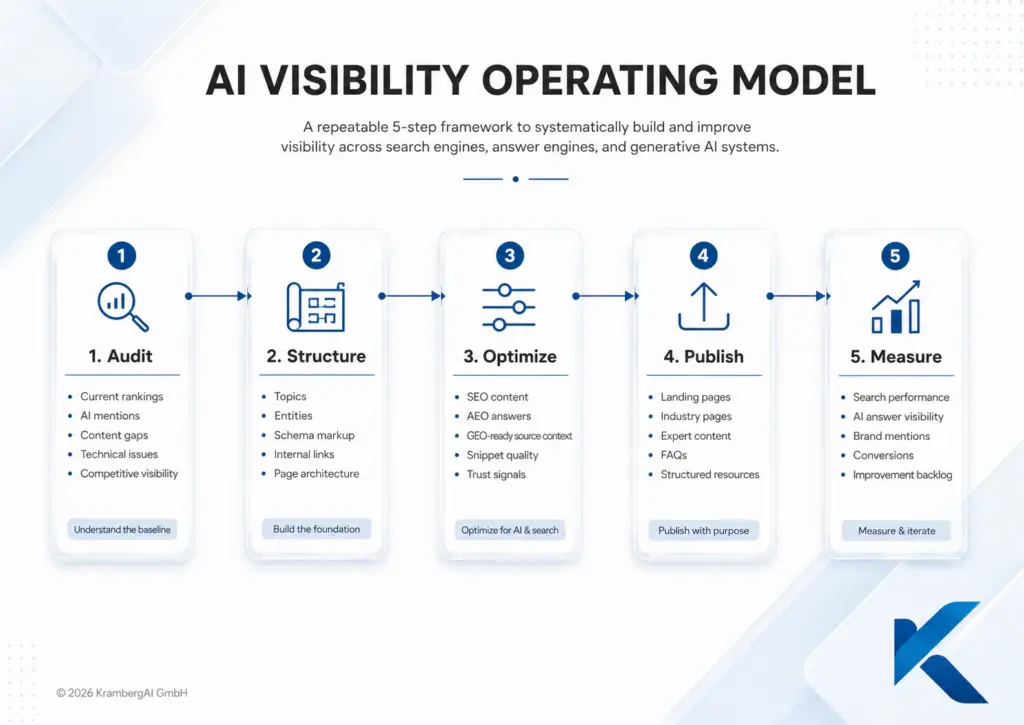
Why is AI visibility moving into commercial research?
Generative search initially appeared most frequently for informational questions. It is now expanding into product evaluation, vendor research, software comparison, and other commercial discovery stages.
Semrush, https://www.semrush.com/, analyzed more than 600,000 keywords across ten industries between November 2025 and April 2026. The share of commercial-intent search result pages containing an AI Overview increased by an average of 71 percent during the study period.
This makes GEO relevant to more than educational articles. Comparison pages, service descriptions, buying criteria, implementation guides, cost models, case studies, and vendor profiles can all support generated answers.
A buyer may not begin by searching for a specific consulting company. The research journey may start with questions such as:
- What data does an enterprise AI assistant require?
- How does an AI agent connect to an ERP?
- When should a company use a private AI environment?
- What is the difference between RAG and a Company Brain?
- How much organizational work is required before an AI pilot?
- Which workflows should remain under human approval?
- How can a company avoid AI platform lock-in?
The providers that answer these questions well can become visible before a formal buying process begins.
How do AI search systems find supporting sources?
Although each product uses its own technology, the process usually includes several stages. A system interprets the user’s request, decides whether external retrieval is needed, issues one or more searches, evaluates candidate pages, allocates available context, generates an answer, and may attach citations.
A page can fail at any stage. It may be blocked from crawling, excluded from an index, considered irrelevant, outranked by another source, omitted because of limited context capacity, or used without receiving a prominent citation.
This is why GEO cannot be reduced to writing style. Technical access, topic relevance, brand authority, source trust, freshness, and content structure all contribute to the outcome.
Generated answers may also vary across repeated requests. Model versions, location, language, phrasing, personalization, current web data, and source availability can change the selected pages.
Companies should treat GEO visibility as probabilistic. The goal is to improve the likelihood of accurate inclusion across relevant questions, not to guarantee one permanent ranking position.
How should content be structured for direct reuse?
A useful GEO section often starts with a specific question. The opening sentences provide the answer. The section then explains conditions, process, limitations, evidence, and practical application.
This does not require every article to become a list of short fragments. Complex subjects still need detailed explanation. The important point is that the main answer should not be buried beneath several paragraphs of broad introduction.
A practical pattern is:
- Direct response: Answer the question in two to four sentences.
- Scope: State when the answer applies.
- Method: Explain the required steps.
- Constraints: Identify situations in which the method is unsuitable.
- Example: Show how it works in an operating environment.
- Evidence: Provide a source, method, result, or documented experience.
This approach makes individual claims easier to interpret while preserving enough context to prevent oversimplification.
The structure should follow the information need. A technical decision may require a comparison table. A process may require a sequence. A compliance subject may require definitions, scope, responsibilities, and citations.
Why do specific questions outperform generic topic pages?
A heading such as “Benefits of artificial intelligence” can refer to productivity, quality, sales, staffing, service, risk, or cost. The subject is too broad to support a focused answer without additional interpretation.
A question such as “Which records should an AI agent review before preparing a field service work order?” creates a defined information need. The page can discuss the customer record, contract entitlement, installed asset, prior incidents, technician qualification, parts history, and approved procedures.
Specific questions provide several advantages:
- They represent real search and sales conversations.
- They limit the scope of the response.
- They support meaningful internal linking.
- They expose missing evidence.
- They can be monitored as a defined topic.
- They connect more naturally to a business decision.
A company should not create a separate page for every minor wording variation. Google states that its systems can understand synonyms and related meaning. Publishing near-duplicate pages for every long-tail phrase is unnecessary and can create weak site architecture.
One substantial page can address several closely related questions. A separate page is justified when a subtopic has a distinct audience, decision, or depth requirement.
Why does first-hand experience matter more in AI search?
General definitions are widely available. First-hand observations, operating data, implementation lessons, and decision methods are more distinctive.
A company can publish information such as:
- which source data was missing during a pilot;
- which integration consumed more effort than expected;
- why an automation failed after deployment;
- which approval roles were necessary;
- how processing time changed;
- which requirements customers should complete before implementation;
- what the solution does not handle effectively.
This material does not require disclosure of confidential customer information. Companies can anonymize examples and publish recurring patterns, decision logic, and aggregated results.
Balanced analysis is particularly valuable. A page should state when an approach is unsuitable, when manual review remains necessary, and which assumptions affect the result.
Original diagrams, operating models, templates, screenshots, and comparison frameworks can further strengthen the page. Google notes that images and video may also be included in generative search experiences when they are relevant and properly optimized.
How should companies use data and citations?
AI systems synthesize information from multiple sources. Claims with traceable support are easier to evaluate than unsupported statements.
Strong citation practice does not mean adding a long bibliography to every paragraph. The cited source should genuinely support the relevant claim.
For statistics, companies should link to the original study, regulator, institution, or reporting organization whenever possible. A blog that repeats a number without methodology is a weaker reference.
Companies can also support their own claims through:
- documented project results;
- published methodology;
- original surveys;
- screenshots;
- product documentation;
- calculation models;
- anonymized case data;
- technical specifications.
Dates matter when the subject changes quickly. Software features, regulations, prices, and market statistics should include publication or review dates.
Evidence should appear near the relevant statement. A disconnected list of sources at the bottom makes verification more difficult and may not show which source supports which assertion.
How do consistent entities improve AI visibility?
AI search needs to identify the organization, its services, its products, its people, and the relationships among them.
Core business information should remain consistent across the company website and external profiles:
- legal and brand name;
- service names;
- product names;
- website and contact details;
- locations and service areas;
- leadership and authors;
- industry specialization;
- relationships between products and services.
A company should not describe one service as “Company Brain” on its website, “enterprise knowledge bot” in directories, and “corporate AI database” in interviews unless the relationship among those terms is documented.
An authoritative company profile, service pages, author profiles, legal information, contact pages, and structured organization data all support entity recognition.
External profiles should repeat the same essential facts. Small inconsistencies in punctuation are not the issue. The problem arises when names, locations, services, and company descriptions contradict one another.
Multilingual sites need the same discipline. English pages should be localized for the market while preserving product relationships and corporate facts across languages.
What role does structured data play in GEO?
Schema.org markup can describe organizations, people, articles, products, services, events, job listings, and frequently asked questions in a machine-readable form.
This supports entity interpretation and eligibility for certain search enhancements. It is not a dedicated GEO switch.
Google states that no special Schema.org type is required for AI Overviews or AI Mode. Structured data remains useful as part of a broader search strategy, but it does not guarantee inclusion in a generated answer.
The markup must match the visible page. Companies should not insert services, reviews, prices, or questions into JSON-LD when those details do not appear in the page content.
Commonly relevant types include:
Organization;ArticleorBlogPosting;Service;Product;FAQPage;BreadcrumbList;Event;Person.
Structured data improves machine-readable relationships. It cannot compensate for weak or unsupported content.
What technical foundation does GEO require?
A strong article cannot become a source when search crawlers cannot retrieve or process it.
The technical foundation includes:
- indexable HTML;
- correct response codes;
- internal links;
- XML sitemaps;
- appropriate canonical tags;
- mobile usability;
- acceptable performance;
- accessible main content;
- controlled duplicate URLs;
- appropriate language annotations;
- intentional robots.txt rules.
Google requires a page to be indexed and eligible for a standard search snippet before it can appear as a supporting link in AI Overviews or AI Mode. No additional technical qualification is required.
For ChatGPT Search, OAI-SearchBot must not be blocked. OpenAI, https://openai.com/, also notes that hosting, security systems, and content delivery networks must permit traffic from its published IP ranges.
Companies should distinguish between OpenAI crawlers. OAI-SearchBot supports search discovery, while GPTBot relates to model development. Search access and training access can therefore be managed separately.
JavaScript-heavy sites also require additional attention. Critical content should render reliably and should not depend on interactions a crawler cannot perform.
Does a website need an llms.txt file?
An llms.txt file is intended to provide AI systems with a machine-readable summary of important website resources. It may be useful for individual tools or private integrations.
Google states that llms.txt is not required for Google Search, AI Overviews, or AI Mode. Google does not use the file as a ranking or visibility signal. It also does not require a special AI markup file or a Markdown copy of the website.
A company may still publish an llms.txt file when a specific service uses it. The file should not be treated as an alternative to indexable pages, good navigation, source citations, or maintained content.
It also creates another maintenance responsibility. An outdated machine-readable summary can conflict with the current website. The file should therefore have an identified owner and update process.
Why do third-party mentions matter?
A company can describe its own expertise on its website. Independent sources provide external confirmation of the relationship between the brand, industry, service, and subject.
Relevant sources may include:
- trade associations;
- industry publications;
- manufacturer partner directories;
- customer case studies;
- conference agendas;
- government directories;
- university partnerships;
- reputable review platforms;
- podcasts;
- interviews;
- professional research.
The objective is not maximum mention volume. One contextually relevant feature in a respected industry publication can be more useful than many generic directory listings.
Companies should avoid artificial mentions, mass link buying, or fabricated citations. Google identifies inauthentic mentions as an ineffective approach.
Useful digital public relations provides material that other organizations have a reason to cite: original studies, benchmarks, expert analysis, implementation data, checklists, and documented case results.
How should local and regional companies approach GEO?
Local service companies need consistent location, contact, service area, and business-category information.
Google Business Profile, https://www.google.com/business/, Bing Places for Business, https://www.bingplaces.com/, relevant directories, and the company website should contain matching core information.
Location pages should provide more than a city name inserted into a template. Useful regional content can include:
- actual service coverage;
- local response models;
- regional customer segments;
- local regulations;
- area-specific projects;
- regional contacts;
- documented availability;
- local case studies.
Microsoft, https://www.microsoft.com/, recommends maintaining current business information and using Bing Places to support eligibility for location-based AI responses.
A smaller number of substantial location pages is generally preferable to hundreds of near-identical pages.
Which content formats work particularly well?
There is no single best GEO format. Different decisions require different structures.
Decision guides
These pages answer a management or operational question and explain options, requirements, and limits.
Comparisons
They evaluate products, architectures, or operating models against stated criteria.
Case studies
They show the initial condition, work performed, obstacles, result, and transferable lesson.
Checklists
They help a user prepare for a defined process or evaluate readiness.
Technical glossaries
They explain not only what a term means but why it affects a real implementation or decision.
Frequently asked questions
They address recurring questions when each answer contributes meaningful information.
Original research
Surveys, benchmarks, and operational data can become source assets for both publishers and AI systems.
The format should support the task. A comparison table is useful for vendor selection. A process redesign requires a sequence and responsibility model. A compliance subject needs scope, source authority, and review dates.
Why do mass-produced AI articles usually underperform?
Generative tools can produce large amounts of polished text quickly. Without original inputs, the output is usually another summary of information already available elsewhere.
The page may read well while contributing no new measurement, case detail, technical method, or decision framework. Search and AI systems have little reason to select it instead of an established source.
Google permits the use of generative tools but continues to require people-first, reliable, useful content. Large-scale generation without additional value may violate its spam policies.
AI is useful for research preparation, outlining, rewriting, content audits, and organizing original source material. Subject-matter review remains necessary.
A strong workflow includes source verification, practical detail, removal of generic repetition, and review by someone accountable for the published information.
What common GEO tactics fail in practice?
One common failure is treating GEO as a collection of shortcuts. The company publishes an llms.txt file, adds generic FAQ sections, and creates large numbers of AI-written pages. The core content remains interchangeable.
Another failure is targeting one exact prompt. AI systems may decompose the question differently or use different retrieval sources depending on user context. A page needs genuine subject depth rather than a sentence designed to imitate one query.
Overstated marketing language also weakens usefulness. A page that describes every solution as the leading choice for every company provides little help during evaluation.
Other common problems include:
- outdated content;
- inconsistent product descriptions;
- unsupported statistics;
- invented citations;
- blocked search crawlers;
- key information available only inside images or inaccessible PDFs;
- duplicated location pages;
- direct translation without market localization;
- missing relationships between company, service, and expertise;
- measurement based only on website sessions.
GEO usually fails because the organization lacks content and technical governance, not because a specific keyword is missing.
How should companies measure GEO visibility?
GEO reporting needs several layers.
Technical availability
Are priority pages indexed? Can relevant crawlers reach them? Are structured data and language signals valid?
Citations
Which URLs are cited in generated answers? Which grounding questions lead to those pages?
Brand mentions
Is the company mentioned without a link? Which capabilities are associated with it?
Representation accuracy
Are services, locations, products, and limits described correctly?
Referral traffic
Which visits arrive from ChatGPT, Microsoft Copilot, Perplexity, and other AI services?
Business outcomes
Do those visitors request information, book meetings, download assets, or enter qualified sales conversations?
Microsoft introduced an AI Performance report in Bing Webmaster Tools in February 2026. It includes citation counts, cited URLs, selected grounding queries, and citation trends across Microsoft Copilot, Bing AI answers, and selected partner experiences.
OpenAI states that publishers allowing OAI-SearchBot can measure ChatGPT referral traffic through standard analytics platforms.
Companies should also maintain a recurring prompt set. Because generated answers vary, each test should include multiple runs, alternative wording, and a documented date.
Which metrics belong in a GEO dashboard?
| Measurement area | Example metric |
| Technical foundation | Indexed pages, crawler errors, blocked bots |
| AI presence | Citations and cited URLs |
| Topic coverage | Questions and subject clusters producing visibility |
| Brand position | Mention, associated capability, and answer placement |
| Competitive context | Providers and sources appearing together |
| Referral acquisition | Sessions from AI search services |
| Engagement | Meaningful page actions and next steps |
| Commercial impact | Leads, meetings, and assisted opportunities |
| Content governance | Outdated pages, missing evidence, and review backlog |
The dashboard should focus on trends rather than isolated responses. Location, language, model version, personalization, and current web data can affect individual results.
GEO monitoring is therefore closer to market observation than to a fixed daily rank check.
How do AI referrals differ from traditional organic traffic?
AI search referrals may have lower volume than traditional search traffic, but their intent can be different.
A user who clicks after reading a generated answer has already received an initial explanation, compared alternatives, or identified a specific implementation question. The visit may therefore begin deeper in the decision process.
Companies should compare:
- conversion rate;
- content depth;
- time to inquiry;
- visited service pages;
- branded searches;
- sales qualification;
- assisted pipeline.
Referral tracking is not perfect. Some AI interactions may lead to direct visits or branded searches that are not attributed to the original answer.
This is another reason not to value GEO only through last-click analytics. Sales conversations can include a source question such as “Where did you first hear about us?” or “Which research influenced your inquiry?”
What does a practical midmarket GEO use case look like?
A field service technology provider wants to become visible for AI-enabled service operations. A generic service page stating “We automate your field processes” provides little source value.
A stronger topic system could include:
- How does an AI system assign an incoming request to the correct asset?
- Which records should be available before dispatch?
- How does mobile documentation work without reliable connectivity?
- When may an AI assistant send a customer message automatically?
- How should recurring technical faults be stored?
- Which system remains authoritative for orders, customers, and documents?
- What permissions should a service agent receive?
- How should the company measure first-time-fix improvement?
Each page gives a direct answer, operating conditions, limitations, and an example. A case study adds the data preparation required before a pilot and identifies which decisions remained with dispatch.
The central service page connects those resources to the company’s offering. It explains the target customer, delivery scope, integrations, privacy model, pilot process, and contact path.
The result is a subject system rather than an unrelated blog archive. It helps search systems associate the company with a defined operating capability.
How should a twelve-week GEO pilot be organized?
Weeks 1 and 2: Collect customer questions
The company gathers real questions from sales calls, service tickets, customer success, search data, and consulting work. Questions are prioritized according to commercial relevance, expertise, and existing demand.
Weeks 3 and 4: Audit current pages
Existing content is reviewed for search intent, depth, source quality, date sensitivity, overlap, and technical access. Pages are consolidated where several weak articles cover the same subject.
Weeks 5 through 7: Improve priority content
Selected pages receive direct answers, evidence, practical examples, comparison tables, limitations, and purposeful internal links. Product and company information is standardized.
Weeks 8 and 9: Address technical access
The company reviews robots.txt, sitemaps, canonical tags, international targeting, structured data, performance, and OAI-SearchBot access.
Weeks 10 and 11: Develop external validation
The business contributes research, expert commentary, case studies, or industry articles to credible external platforms.
Week 12: Establish measurement
A prompt set, citation baseline, referral segments, search performance, and conversion reporting are documented.
The pilot should focus on one commercially important topic. Updating the entire website at once makes it difficult to understand which changes produced an effect.
How should companies maintain GEO content?
AI visibility requires ongoing content operations. Products change, regulations evolve, competitors publish new research, and customer questions shift.
Every priority page should have:
- a subject owner;
- a review date;
- source records;
- an applicable scope;
- a connection to relevant services;
- a process for superseded content;
- a revision history where appropriate.
Updating does not mean changing the displayed date without reviewing the content. Statistics, product behavior, legal requirements, and links must be checked.
Sales and service teams are important sources of new topics. When the same customer question appears repeatedly, the public content system may be missing an answer.
The strongest GEO programs connect subject experts, content, SEO, public relations, sales, and technical operations. Keyword tools help, but many of the most valuable topics originate inside customer work.
What actually improves GEO visibility over time?
A page needs a defined job. It should answer a real question instead of merely occupying a broad keyword category. Claims need evidence, context, and limitations. Business facts should remain consistent across owned and external profiles.
The technical foundation remains familiar: crawling, indexing, internal links, mobile access, and reliable page rendering. Special AI files do not replace these fundamentals.
Original information has the greatest potential to differentiate a source. Field experience, operational data, documented methods, comparisons, and honest implementation boundaries give an AI system a reason to use one company’s content.
Measurement must also evolve. Clicks remain important but do not represent the entire discovery process. Companies need to monitor citations, brand mentions, attributed topics, referral quality, and influenced customer decisions.
Improving GEO visibility is not about writing for machines. It is about publishing business knowledge in a form that people and automated systems can interpret, verify, and apply.
Which sources support the statistics used in this article?
- Google: AI in Search – Going Beyond Information to Intelligence
Statistic used: AI Overviews increased Google usage by more than 10 percent for affected query types in major markets such as the United States and India.
https://blog.google/products-and-platforms/products/search/google-search-ai-mode-update/ - Pew Research Center: Do People Click on Links in Google AI Summaries?
Statistics used: Traditional results received clicks during 8 percent of visits with an AI summary, compared with 15 percent without one; links inside the AI summary received clicks during 1 percent of visits.
https://www.pewresearch.org/short-reads/2025/07/22/google-users-are-less-likely-to-click-on-links-when-an-ai-summary-appears-in-the-results/ - Semrush: AI Overviews Are Expanding Across Commercial Intent Search
Statistic used: The share of commercial-intent result pages containing AI Overviews increased by an average of 71 percent during the six-month study.
https://www.semrush.com/blog/ai-overviews-commercial-search-study/
Which additional resources provide useful guidance?
Further reading
- Google Search Central: Optimizing for Generative AI Features in Google Search
https://developers.google.com/search/docs/fundamentals/ai-optimization-guide - Microsoft Bing: AI Performance in Bing Webmaster Tools
https://blogs.bing.com/webmaster/February-2026/Introducing-AI-Performance-in-Bing-Webmaster-Tools-Public-Preview - OpenAI: Publishers and Developers FAQ
https://help.openai.com/en/articles/12627856-publishers-and-developers-faq
Frequently Asked Questions
What is GEO and how does it differ from SEO?
GEO focuses on visibility inside generated answers that combine several sources. SEO remains the technical and content foundation because AI search still depends on crawling, indexing, retrieval, authority, and relevance. GEO adds citation monitoring, entity consistency, third-party validation, and analysis of how a company is represented inside AI-generated responses.
Does a company need to create new content for GEO?
Not always. Updating established pages can produce faster value than publishing additional articles. Existing pages can receive direct answers, stronger evidence, practical examples, better internal links, and updated facts. New pages are justified when an important customer question has no suitable answer or requires a separate audience, decision process, or level of technical depth.
Which content is most likely to appear in AI answers?
No universal public ranking formula exists. Accessible pages with focused subject coverage, verifiable evidence, consistent entities, original experience, and useful answers provide a strong foundation. Inclusion cannot be guaranteed because retrieval varies by system, query, language, location, current web data, and model version. Companies should optimize for repeated usefulness rather than one specific generated response.
Does FAQ schema improve GEO visibility?
FAQ schema can identify questions and answers in a machine-readable format and remains a useful structured-data type when the visible page contains the same content. It does not guarantee citation in an AI answer. A large FAQ section with generic answers cannot replace a substantial article, original evidence, or a technically accessible page.
Is an llms.txt file required for GEO?
Google does not require llms.txt for Search, AI Overviews, or AI Mode and does not use it as a ranking or visibility signal. Other tools may support the format voluntarily. A company should publish and maintain the file only when it serves a documented purpose. It does not replace HTML pages, crawling, internal links, or source governance.
How can a website appear in ChatGPT Search?
The website must be publicly available and must not block OAI-SearchBot. The hosting provider, firewall, and content delivery network must also permit traffic from OpenAI’s published IP ranges. Inclusion and placement are not guaranteed. Source relevance, reliability, current availability, and the specific user question influence which pages ChatGPT Search retrieves and cites.
How important is structured data for GEO?
Structured data helps search systems identify companies, people, articles, services, products, and relationships. It remains useful for search eligibility and entity interpretation but is not a special GEO ranking mechanism. The markup must match the visible content. Strong pages still require accessible HTML, useful information, internal links, evidence, and consistent company facts.
How should a midmarket company measure GEO performance?
The company should combine citation counts, brand mentions, cited pages, AI referral traffic, representation accuracy, and business outcomes. A recurring question set can track trends over time. Search Console, Bing Webmaster Tools, and web analytics provide additional evidence. Individual generated answers should not be treated as stable rankings because system output can vary.
How often should GEO content be reviewed?
Review frequency depends on the subject. Software capabilities, prices, regulations, and market statistics need more frequent checks than stable educational material. Each priority page should have an accountable subject owner and review schedule. Updating the displayed date without verifying the facts does not improve the page and can reduce reader trust.
Which GEO action usually produces the fastest improvement?
The fastest improvement often comes from upgrading priority pages that already receive impressions or support customer conversations. Direct answers, first-hand experience, authoritative sources, internal links, and consistent service descriptions can be added without rebuilding the site. Technical crawler blocks should be checked first because inaccessible content cannot be selected regardless of its editorial quality.
All articles about visibility in AI systems
