
MCP for the Company Brain standardizes how AI agents retrieve, interpret, and use approved organizational knowledge. A CLI makes the same capabilities available in terminals, scripts, and automated workflows. Sustainable value depends on governed permissions, traceable actions, and well-structured business data rather than on selecting the largest available language model.
Why do AI agents need governed access to a Company Brain?
Many companies have already introduced generative AI for writing, document analysis, research, and internal assistance. These applications can improve individual productivity, but they do not automatically understand the operational environment in which a company works.
A general-purpose model does not know which proposal version is current, which service-level agreement applies to a customer, which installation manual has been approved, or which employee may authorize a contract change. It may produce fluent language while overlooking the details that determine whether an answer is useful, outdated, or commercially risky.
An operational AI agent therefore needs more than a prompt containing a few copied documents. It needs a governed path to company-specific knowledge, business rules, source systems, and approved actions. The Company Brain provides that knowledge layer. MCP and CLI provide different ways of reaching and using it.
Make company knowledge easier to access
The KrambergAI Company Brain makes scattered knowledge from documents, projects, processes and internal sources easier to find and prepares answers with traceable context.
Implemented pragmatically · Source-based answers · Made in Germany
The economic context makes this capability increasingly relevant. Bitkom e. V. (https://www.bitkom.org/) reports that 77 percent of German companies already using AI have improved their competitive position. Gartner, Inc. (https://www.gartner.com/) expects as many as 40 percent of enterprise applications to include task-specific AI agents by the end of 2026. Gartner also predicts that one-third of agentic implementations will combine agents with different capabilities in 2027. rtant management question is therefore no longer limited to model selection. Companies must decide which sources an agent can access, which user identity it represents, which tools it may invoke, what it must document, and when a human approval is required.
How are MCP and CLI different?
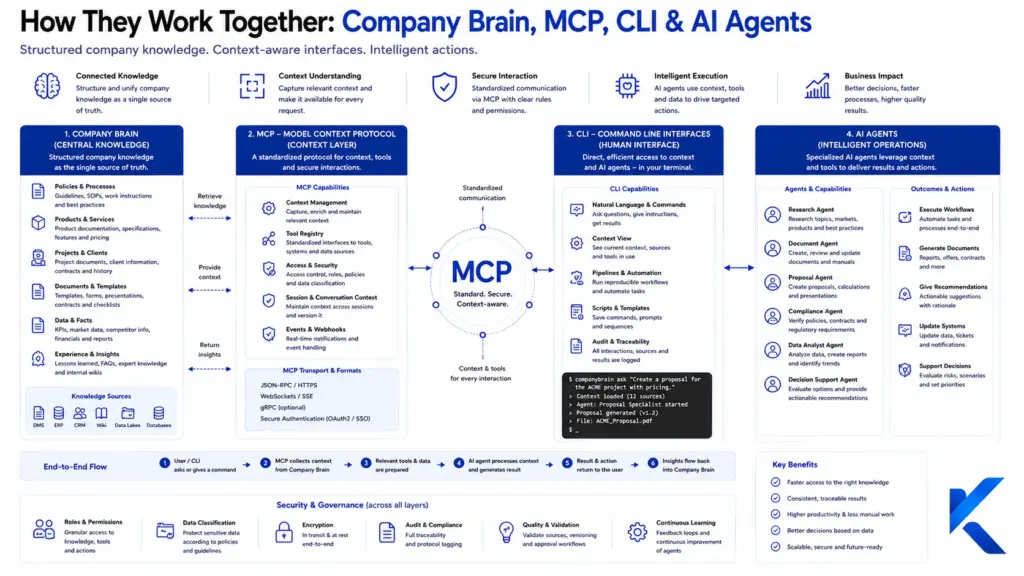
MCP stands for Model Context Protocol. It defines a standardized communication layer through which an AI application can discover and use external resources, tools, and services. An MCP server might expose a document search function, retrieve a record from a business system, calculate a technical value, or initiate an approved workflow.
A command line interface, or CLI, serves a different purpose. It allows a developer, administrator, power user, or automated process to run an AI agent from a terminal. Parameters can be supplied through commands, outputs can be returned as structured data, and the workflow can be integrated into scripts, deployment pipelines, scheduled jobs, or internal engineering processes.
MCP primarily defines how the agent communicates with an external capability. The CLI defines how a person or machine launches, controls, and integrates the agent.
The two layers work well together. A CLI-based agent can connect to one or more MCP servers that expose selected Company Brain capabilities. Users no longer need to paste sensitive content into every prompt or build a separate integration for every AI client. Current CLI platforms already support MCP configuration files, tool restrictions, permission modes, non-interactive execution, and schema-validated output for downstream automation. oes the technical access chain work?
A production architecture should not connect a language model directly to an operational database. Several technical and organizational control points belong between the user request and the underlying business system.
The entry point may be a chat application, industry portal, service interface, internal application, or CLI. This application acts as the MCP host. An MCP client inside the host manages the connection to an MCP server. The server exposes a limited business capability or a selected segment of organizational knowledge.
The official MCP architecture distinguishes among resources, tools, and prompts. Resources provide content such as files, database records, schemas, or API responses. Tools execute defined functions such as searches, calculations, file operations, or API calls. Prompts provide reusable interaction templates for specific tasks. MCP uses a JSON-RPC data layer and supports both local process communication and remote HTTP-based communication. cal Company Brain access chain may look like this:
User or business process → AI agent → policy and authorization layer → MCP client → specialized MCP server → Company Brain services → approved source systems.
The Company Brain services may include semantic search, a document management platform, CRM data, ERP records, ticketing systems, file stores, product information, or internal databases. The agent should not receive unrestricted access to these systems. Instead, each MCP server should offer a limited, documented interface designed for a specific business purpose.
A sales agent may need a function that retrieves approved reference projects and current product information. It does not need unrestricted access to payroll data. A field service agent may retrieve equipment history and maintenance instructions but should not create a billable order without a separate authorization step.
This division creates a practical boundary between reasoning and execution. The model can decide which approved capability is relevant, while the enterprise architecture determines what that capability is allowed to do.
What does the Company Brain contribute?
A Company Brain is not merely a vector database containing uploaded documents. It is an organizational knowledge layer that connects content, structured data, terminology, processes, responsibilities, permissions, and source provenance.
For an AI agent, the Company Brain becomes a governed source of business context. It does not need to autonomously decide every commercial action. Its purpose is to make the right information and approved capabilities available in a form the agent can use.
Metadata is essential. Documents and records may need attributes such as version, validity period, customer, project, site, asset, product line, equipment type, responsible team, or confidentiality level. Without those attributes, a retrieval system may find a relevant-looking document but fail to determine whether it applies to the current case.
In a heating, ventilation, and plumbing service company, searching for a heat pump fault is rarely sufficient. The agent may need the manufacturer, product generation, installation configuration, prior service history, warranty status, and applicable maintenance agreement.
In traffic safety operations, an agent may need to combine the work location, approved traffic plan, project documentation, local requirements, and prior inspection records. A general answer about traffic control rules cannot replace the information attached to the specific project.
For technical service providers, the required context may include serial numbers, site history, customer agreements, documented deviations, replacement parts, and previous technician notes. The Company Brain connects those information objects. MCP delivers them through a standardized interface, while the CLI makes them available to technical users and automated workflows.
Which access method fits each business scenario?
| Access method | Typical use | Advantages | Limitations and risks |
|---|---|---|---|
| MCP | Connecting AI agents to knowledge, tools, and business systems | Standardized tool definitions, dynamic discovery, reusable across compatible AI clients | Requires permissions, monitoring, maintained schemas, and operational ownership |
| CLI | Terminal workflows, scripts, engineering analysis, DevOps, and batch processing | Reproducible, automatable, suitable for pipelines and structured output | Requires protection against command injection, unrestricted shell use, and exposed credentials |
| Direct API | Deterministic system-to-system integration | Predictable behavior, strong control, efficient execution | Every integration must be developed and maintained separately |
| Retrieval-only RAG | Answering knowledge questions without transactional actions | Suitable for limited read access and an initial pilot | Does not provide a standardized action layer or full workflow support |
MCP does not replace existing APIs. It can wrap approved APIs and present them as reusable capabilities that different AI applications can discover and invoke.
A CLI does not replace a process-specific user interface either. It is particularly useful for developers, administrators, analysts, and automated jobs. Field technicians, sales representatives, and service coordinators will often work more effectively through a purpose-built application that uses the same MCP services behind the scenes.
The decision should follow the process rather than the technology. A deterministic transfer between two systems may still belong in a traditional API integration. An agent becomes useful when a task requires interpretation, retrieval across several sources, contextual decisions, or the selection of an appropriate approved tool.
Which use cases are practical for mid-sized companies?
The strongest use cases usually involve recurring knowledge work in which employees search across several systems, manually transfer information, or request missing context from other departments.
During proposal preparation, an agent can retrieve approved reference projects, previous calculation components, technical specifications, contractual requirements, and customer-specific conditions. A CLI workflow can apply the same process to a collection of incoming tender documents. The result should be a structured working package with sources, assumptions, missing information, and identified risks rather than an automatically binding proposal.
In technical service operations, an agent can combine equipment history, prior fault reports, spare-part information, maintenance intervals, warranty status, and contractual service boundaries. The technician receives case-specific preparation rather than a generic troubleshooting checklist.
For service documentation, photographs, measurements, checklists, and technician notes can be linked to the correct job. An agent can identify missing mandatory fields, draft the service summary, and place the result in the appropriate review queue. The responsible employee remains accountable for approval.
In sales and customer service, the agent can summarize meeting notes, open activities, previous proposals, product information, and unresolved support issues. An MCP write tool may prepare a CRM note, while the final transmission of a proposal or change to a contractual status requires an additional approval.
Quality management provides another practical scenario. An agent can search for repeated deviations, missing inspection records, obsolete procedures, or conflicting instructions across sites. It can prioritize findings and provide source references, while the quality manager performs the formal assessment.
CLI-based access is also useful for internal IT and data teams. They can run repeatable checks against documentation collections, compare configuration records, classify incoming files, generate migration reports, or validate whether required metadata is present before content becomes available to other agents.
How should access to confidential company data be protected?
The core principle is that an agent must not receive broader access than the user or technical service it represents.
The current authorization specification for remote MCP servers uses established OAuth mechanisms for discovering authorization services and requesting scoped access. In an enterprise environment, that protocol support must be connected to the existing identity provider, role model, group structure, and application permissions. employee should only retrieve customers already available to that employee in the CRM. An external service partner may receive access to the documentation for a specific asset but not to internal pricing, unrelated customer projects, or personnel data. Administrative access to configure an MCP server should not automatically provide permission to read every business document behind it.
Read and write capabilities should be separated. Read tools retrieve information and support analysis. Write tools change records, send messages, create orders, or trigger workflows. Higher-risk actions should include a preview, confirmation step, dual approval, or final authorization in the business application.
Every relevant tool invocation should generate an audit record. The record should identify the acting user or service, the agent, the selected tool, the affected business object, the outcome, and any approval involved. Sensitive content should not be copied into logs without purpose, and retention rules should follow the organization’s security and privacy requirements.
The risk is not theoretical. IBM (https://www.ibm.com/) reported that one in five organizations in its study experienced a breach associated with ungoverned shadow AI. itecture should also assume that retrieved content may contain malicious or misleading instructions. A document, email, support ticket, or website may tell the agent to ignore its operating rules or disclose additional data. Such content must be treated as business data, not as an authorized system instruction.
What usually goes wrong in MCP and CLI implementations?
A common mistake is to treat an existing file share as a production-ready Company Brain. Drafts, obsolete procedures, duplicate documents, and files without ownership are indexed together. The agent can retrieve text, but it cannot reliably determine which source governs the current process.
Another problem is an overly broad MCP tool. A function called “manage_customer” with many optional parameters is difficult to authorize, test, and monitor. Narrower tools such as “find_customer,” “retrieve_open_service_cases,” or “prepare_crm_note” provide stronger boundaries and more predictable behavior.
Tool descriptions are also frequently neglected. The model chooses tools based partly on their names, descriptions, parameter schemas, and returned results. Ambiguous naming can cause the agent to invoke the wrong capability even when the underlying API is working as designed.
Returning too much data creates a separate failure mode. An MCP server that sends entire document archives or extensive database records into the model context increases cost, latency, and the likelihood of irrelevant information affecting the answer. The server should filter, rank, and structure results before returning them.
Unreviewed agent output is another operational risk. Accurate source documents do not guarantee an accurate conclusion. The model may combine facts incorrectly or overlook an exception. Production workflows should therefore provide source references, assumptions, status information, and unresolved questions.
CLI implementations introduce additional risks. Credentials may be stored in local configuration files, user input may be passed directly into shell commands, or the agent may receive access to an entire home directory. Production environments should restrict working directories, commands, network destinations, environment variables, and credential lifetimes.
A lack of structured output also causes automation failures. If the agent returns a different free-form response on every run, downstream systems cannot process the result reliably. JSON schemas, required fields, controlled status values, and machine-readable errors are more suitable for automated workflows.
Finally, many projects connect too many systems at once. A narrow process used every day provides better operational evidence than a broad agent that theoretically sees the entire organization but cannot be governed or evaluated effectively.
How should a production-oriented pilot be designed?
A useful pilot begins with a limited task that has repeatable inputs, an accountable business owner, and an observable result. It should solve a real operational problem rather than demonstrate a collection of disconnected technical features.
The team first defines the question or action the agent will support. It then identifies required sources, user roles, exclusion rules, expected outputs, and conditions that require escalation. Only after those decisions should the team determine which information will be exposed as resources and which actions will become MCP tools.
Read-only access is often the most appropriate starting point. The agent retrieves information, prepares a case, identifies missing fields, or drafts a response without modifying operational records. This allows the organization to evaluate source quality, metadata, retrieval behavior, and employee acceptance with limited transactional risk.
Controlled write capabilities can follow. Each tool should have validated inputs, a defined result, predictable failure handling, and protection against duplicate execution. A function that creates a CRM note, for example, should require a valid customer identifier, store the note as a draft when appropriate, and return a transaction reference.
Testing should use actual operating scenarios. The evaluation set should include routine requests, incomplete information, outdated records, contradictory sources, unauthorized requests, unusual customer cases, and content designed to manipulate the agent. A polished demonstration is not sufficient evidence for deployment.
Operational ownership must also be assigned. Someone needs to maintain the source mappings, tool descriptions, permissions, test cases, logs, and incident procedures. Without that ownership, even a technically successful integration will degrade as systems and business rules change.
KrambergAI GmbH (https://krambergai.com/) develops these access layers around the business process, available knowledge, and existing authorization structure. The technical connector is only one component. Data stewardship, process responsibility, evaluation, and production monitoring determine whether the agent remains useful over time.
Why does the long-term advantage extend beyond the language model?
Language models are becoming increasingly interchangeable. Pricing, context limits, tool capabilities, and model performance continue to change. A company should therefore avoid designing its knowledge architecture around the proprietary behavior of a single model provider.
MCP can provide a degree of separation between the AI client and the business capability. A maintained MCP server may expose the same approved search or workflow function to several compatible agents and interfaces. This does not remove every platform dependency, but it can reduce the cost of changing models or user experiences.
The durable asset is the company’s structured operational knowledge: documented experience, linked cases, approved procedures, defined terminology, source provenance, maintained metadata, and enforceable permissions. A capable model can use that foundation more effectively, but it cannot manufacture it from incomplete or unmanaged information.
The competitive advantage therefore comes from turning organizational knowledge into governed, reusable capabilities. An agent should not simply be granted permission to “work in the ERP.” It should receive an approved tool for a specific transaction, with validated inputs, defined outputs, and an accountable owner.
MCP and CLI are not a complete enterprise architecture. They are building blocks that can turn a passive knowledge repository into an operational Company Brain that supports employees, applications, and automated processes without abandoning governance.
Which sources support the article’s statistics?
Sources for the statistics
- Bitkom: Almost every company is addressing artificial intelligence
https://www.bitkom.org/Presse/Presseinformation/Digitalisierung-der-Wirtschaft-Unternehmen-beschaeftigen-sich-mit-KI - Gartner: 40 percent of enterprise applications will feature task-specific AI agents by 2026
https://www.gartner.com/en/newsroom/press-releases/2025-08-26-gartner-predicts-40-percent-of-enterprise-apps-will-feature-task-specific-ai-agents-by-2026-up-from-less-than-5-percent-in-2025 - IBM: AI breaches, shadow AI, and insufficient access controls
https://newsroom.ibm.com/2025-07-30-ibm-report-13-of-organizations-reported-breaches-of-ai-models-or-applications%2C-97-of-which-reported-lacking-proper-ai-access-controls
Which resources provide further technical guidance?
Further reading
- Model Context Protocol architecture overview
https://modelcontextprotocol.io/docs/learn/architecture - Model Context Protocol authorization specification
https://modelcontextprotocol.io/specification/2025-11-25/basic/authorization - GitHub: Adding MCP servers for GitHub Copilot CLI
https://docs.github.com/en/enterprise-cloud@latest/copilot/how-tos/copilot-cli/customize-copilot/add-mcp-servers
FAQ
What is MCP for the Company Brain?
MCP for the Company Brain is a standardized connection between an AI application and approved organizational resources. Through MCP servers, an agent can search documents, retrieve records, or use limited business functions. The Company Brain organizes the underlying knowledge, metadata, roles, source relationships, and access rules.
Is an MCP server the same as a database?
No. An MCP server is an access layer that exposes resources, tools, and templates to compatible AI applications. Databases, document repositories, APIs, and search platforms may operate behind it. The server describes and limits what the agent can retrieve or execute while the original information remains in the company’s existing systems.
What role does a CLI play for AI agents?
A CLI allows an AI agent to run in a terminal or automated script. It is useful for engineering analysis, batch processing, development tasks, scheduled jobs, and technical workflows. Through an MCP configuration, the CLI agent can use approved Company Brain capabilities without receiving unrestricted access to every connected source system.
Can MCP connect to ERP, CRM, and document systems?
Yes, when those systems provide suitable APIs, database access, or another supportable integration method. A dedicated MCP server can sit in front of the existing interface and translate agent requests into narrow business functions. It should enforce permissions, validate inputs, handle errors, and record relevant activity.
Should an AI agent receive write access to business systems?
Write access should follow a successful read-only pilot and remain limited to defined actions. Suitable tools have validated inputs, predictable outcomes, and an effective approval model. Contract changes, payments, binding orders, customer communications, and other consequential transactions normally require an additional human authorization step.
How can prompt injection be reduced in MCP workflows?
External documents, websites, emails, and tickets should be treated as untrusted business content rather than authorized operating instructions. Tool restrictions, input validation, separated data scopes, approval requirements, and execution reviews reduce the impact of malicious instructions embedded in retrieved content. The agent must not be allowed to expand its own permissions.
What is the difference between local and remote MCP servers?
A local MCP server runs on the same machine as the AI application and commonly communicates through standard input and output. A remote server is accessed over a network and may serve multiple clients. Remote deployments require additional controls for identity, encrypted transport, authorization, availability, monitoring, and credential management.
How are RAG and MCP different?
RAG adds retrieved knowledge to a model request so the model can answer with company-specific context. MCP goes further by standardizing resources, executable tools, and reusable prompts. A Company Brain can use RAG internally for retrieval and expose that search capability to multiple agents through an MCP server.
What determines the cost of MCP access to a Company Brain?
Cost depends more on source systems, permissions, data preparation, operating model, and automation scope than on the protocol itself. Read-only access to a maintained knowledge base is simpler than transactional integration across several business applications with approvals, resilience, monitoring, audit records, and support responsibilities.
Where should a mid-sized company begin?
A suitable starting point is a frequently used process with limited data, an accountable business owner, and an observable result. The agent should initially retrieve information, summarize a case, identify missing data, or prepare a draft. Additional systems and write capabilities should follow only after permissions, source quality, and output performance have been validated.
All articles about company brain
