
Digital transformation without an IT department succeeds when a company first organizes recurring workflows, information handoffs, and ownership instead of buying disconnected software. An internal business owner directs priorities, data decisions, and external providers. Small, measurable releases create dependable operations, reduce coordination effort, and establish a scalable foundation for automation.
Why does digital transformation without an IT department not require a massive program?
Many small and midsize companies operate without an internal IT department. Technology questions may be handled by the owner, the finance manager, an office administrator, or the employee who has historically managed computers and user accounts. This arrangement can remain workable for years, especially when the company uses only a limited number of applications.
The model becomes fragile when systems need to exchange information, employees require access from multiple locations, or customer and operational data must move across departments. At that point, the main obstacle is rarely the absence of a specific technology. The more significant issue is that nobody has been assigned to coordinate workflows, data ownership, vendors, security requirements, and operational decisions.
A common mistake is to treat digital transformation as a large system replacement. Management immediately starts discussing an enterprise resource planning platform, data migration, custom integrations, and a multiyear implementation. For a company without internal technology leadership, such a program can become too large to govern. Costs appear early, while the operational benefit for order processing, dispatching, purchasing, service delivery, or customer support remains distant.
A more effective starting point is the friction employees experience every day. Where are details entered more than once? Which approvals delay quotes, purchases, and invoices? Where do employees repeatedly request missing documents? Which tasks depend on a specific person’s inbox, spreadsheet, or personal knowledge?
The latest KfW report found that only 30 percent of German midsize companies had recently completed digitalization projects during the reporting period. This does not mean that the remaining businesses lack technology. More often, they lack an initiative that is small enough to begin, relevant enough to receive management attention, and structured well enough to survive daily operational pressure.
Assess where AI can create real value
The KrambergAI AI Readiness Assessment helps companies identify suitable AI use cases, evaluate process readiness and define realistic next steps for structured implementation.
Structured assessment · Practical prioritization · Made in Germany
Where should a midsize company begin?
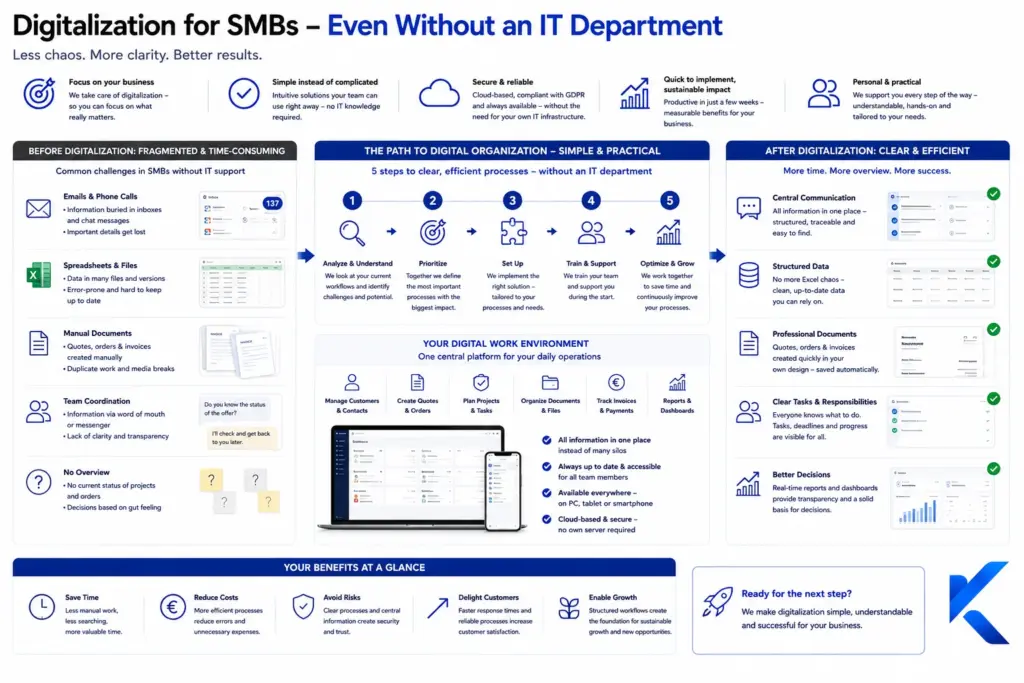
The first step should be a focused workflow review rather than a software search. The company does not need a comprehensive process-modeling project. It needs to follow one real transaction from its initial trigger through completion and identify where information changes hands.
Consider a typical customer order. The process may begin with a phone call or email, followed by data entry, document collection, estimating, scheduling, dispatching, work documentation, customer approval, and invoicing. In many companies, this single workflow is spread across inboxes, spreadsheets, paper folders, messaging apps, and industry-specific applications.
Every transition creates operational exposure. A customer address may be copied incorrectly. A revised drawing may remain in one employee’s inbox. A schedule change may reach the office but not the field team. A completed work report may arrive too late for timely billing. None of these problems requires a sophisticated technology strategy to diagnose. They require attention to the way work moves through the company.
Good starting processes share several characteristics. They occur frequently, affect more than one role, involve repeated information transfers, and create a visible cost when they fail. Common candidates include customer intake, quote preparation, order handoff, field scheduling, mobile documentation, invoice approval, contract storage, and management reporting.
The first project should be meaningful but contained. A rarely used form may be easy to digitize, yet it will not establish momentum. A company gains more by improving a daily workflow that creates recurring delays, rework, or customer frustration.
Who owns the initiative when there is no internal IT function?
A company can outsource technical expertise, but it cannot outsource every business decision. Someone inside the organization must own the operational outcome. This person does not have to be a software engineer or system administrator. The role requires process knowledge, decision authority, and enough time to work with employees and vendors.
For order management, the owner might be the head of sales, an operations manager, or a senior employee in estimating. For scheduling and mobile service documentation, the responsibility may sit with dispatch, field operations, or the service manager. In finance, it may belong to the controller or accounting lead.
The internal owner describes the business objective, identifies mandatory information, approves workflow rules, organizes user testing, and accepts the final process. The external provider evaluates the architecture, configures the application, builds integrations, documents the environment, and supports ongoing operations.
This division prevents two common failures. When a provider receives complete control, the resulting system may function technically but fail to match day-to-day work. When every technical decision remains internal despite limited expertise, projects slow down and employees select disconnected tools on their own.
Senior management should also remain involved at defined decision points. It does not need to approve every field or screen. It should decide priorities, resolve conflicts between departments, approve risk treatment, and confirm who has authority to change established workflows.
Which operating model works for a company without internal IT?
A company does not have to build a full technology department before improving its operations. Several models can work, depending on business size, regulatory exposure, application complexity, and the expected pace of change.
| Operating model | Internal ownership | Main advantages | Typical risks | Best suited for |
|---|---|---|---|---|
| Business team using standard SaaS | Business process owner | Fast launch, limited infrastructure, predictable subscription model | Tool sprawl, inconsistent records, weak integration planning | One contained workflow |
| Traditional managed service provider | Owner, finance lead, or operations manager | Reliable support, endpoint management, identity administration, backups | Strong infrastructure focus but limited process improvement | Stable day-to-day technology operations |
| Fractional digital lead with business owners | Assigned process owners inside the company | Connects operations, applications, data, security, and vendor management | Provider dependence when documentation and access rights are neglected | Growing midsize companies with several initiatives |
| Internal IT department | Technology leader and business departments | High internal control, continuous improvement capacity, shorter internal escalation paths | Hiring difficulty, management overhead, substantial fixed cost | Complex environments with ongoing development demand |
For many midsize businesses, a combined model is the most practical. A managed service provider supports laptops, identities, networks, endpoint protection, backups, and help desk requests. A fractional digital lead or transformation partner coordinates processes, applications, integrations, data ownership, and the improvement roadmap. Business departments remain responsible for requirements and acceptance.
The distinction matters because reliable IT operations and business digitalization are related but not identical. Keeping devices secure and available does not automatically improve order intake, field coordination, or invoice processing. Conversely, automating a workflow without dependable identity management, backup, and support produces a system that may fail when employees need it most.
Which workflows usually produce the fastest operational benefit?
The quickest gains often come from removing manual information transfers. A handoff occurs whenever an employee copies details from an email into a spreadsheet, retypes data from a PDF, forwards attachments to another department, or recreates information already stored elsewhere. These actions consume time and make errors difficult to trace.
Customer intake is a common use case. Instead of receiving unstructured messages, a company can provide a guided form that collects project details, service location, requested date, contact information, photographs, drawings, and required documents. The submission becomes a trackable case, receives an owner, and supplies structured information for estimating, scheduling, or customer follow-up.
Mobile work documentation offers another strong starting point. Field technicians, installers, inspectors, or service crews can record time, materials, photographs, deviations, and customer signoff at the job site. Office employees no longer need to interpret handwritten reports, request missing details, or wait several days before preparing an invoice.
Approval workflows also provide measurable value. Purchase requests, vendor invoices, change orders, discounts, and pricing exceptions can be routed according to predefined authority. The current status remains visible, substitutes can act during absences, and management can later review who approved the transaction.
The first use case should create reusable building blocks. Customer records, project identifiers, user roles, document categories, notification rules, and integration patterns can support later initiatives. This is how a small project begins to establish an operating foundation instead of becoming another isolated tool.
How can separate tools become a sustainable application environment?
A company without internal IT does not necessarily need one large platform. It needs a manageable application environment with explicit system boundaries. A specialized tool may serve a business process better than a broad suite, provided the company knows which application owns each type of information.
A sustainable foundation generally includes identity management, document storage, core business applications, integration mechanisms, backup, and service monitoring. Customer information may be maintained in the customer relationship management system, financial transactions in the accounting or ERP platform, and project files in the document management environment.
The company should avoid storing the same business record independently in several places. When customer addresses, service locations, pricing data, or employee assignments are maintained separately, differences will eventually appear. Integrations should reduce duplicate entry, but they also need ownership. Someone must know which system is authoritative and what happens when an interface fails.
Cloud platforms make adoption easier because the company does not need to operate every server or application stack. In 2025, 54 percent of German companies with at least ten employees purchased cloud services. Adoption at this level shows that cloud delivery has become a normal part of business infrastructure. It does not make vendor selection, permissions, data retention, backups, or exit planning optional.
Before adopting a business-critical platform, management should determine who owns the data, which exports are available, where information is processed, how users are provisioned and removed, which interfaces are supported, how incidents are handled, and how the company can transition to another provider.
These questions are inexpensive to address before implementation. They become expensive when the company discovers several years later that essential records, workflow logic, and configuration knowledge are locked inside a difficult-to-replace service.
How should external technology and digitalization providers be managed?
External specialists are not merely a temporary substitute for an IT department. For many midsize companies, they are a permanent and economically sensible component of the operating model. Germany reported a shortage of approximately 109,000 technology professionals in 2025. Building every role internally may therefore be more expensive and slower than using qualified providers for specialized functions.
However, successful outsourcing requires more than a general monthly support agreement. The contract and operating documentation should identify the systems covered, support priorities, response expectations, maintenance responsibilities, escalation paths, and decision rights during outages or security incidents.
A useful service structure separates four areas.
Operations: identities, devices, updates, backup, monitoring, and user support.
Applications: configuration, access roles, integrations, release coordination, and documentation.
Business improvement: workflow analysis, automation, data quality, adoption, and roadmap planning.
Governance: contracts, privacy obligations, security requirements, recovery procedures, and vendor oversight.
The company should retain administrative access, contractual records, configuration documentation, system inventories, integration details, and contact information. These materials should be stored in a company-controlled location rather than only within the provider’s ticketing system.
Vendor concentration also deserves attention. One provider may be convenient, but management should know which services can be transferred and which depend on proprietary knowledge. The goal is not to replace providers frequently. It is to preserve the company’s ability to act when service quality, pricing, ownership, or strategic requirements change.
Which security and privacy requirements must be included from the beginning?
Security is part of the operating design, not a later enhancement. Even a basic customer form, CRM platform, file-sharing service, or scheduling application processes information that may affect employees, customers, contracts, and revenue.
A practical baseline includes individual user accounts, multifactor authentication, role-based access, maintained software, tested backups, and a documented onboarding and offboarding process. Shared accounts should be avoided because they make it difficult to attribute changes, remove access, and investigate incidents.
The company also needs business rules for sensitive information. Who may export customer records? Who can change payment details? Which employees can view personnel documents? How long are job photographs, proposals, contracts, and service records retained? Who contacts customers, insurers, legal advisers, and providers after an incident?
External platforms should be reviewed for processing terms, subcontractors, storage locations, encryption, deletion procedures, access logging, and recovery capability. For critical workflows, management should define a temporary manual process. Employees need to know how orders, dispatching, field work, or invoicing can continue if a cloud service is unavailable.
Security responsibilities should also appear in provider agreements. The company needs to know who installs updates, reviews alerts, investigates suspicious activity, restores data, and communicates during a disruption. General statements that a provider “handles security” do not establish an operational response.
What commonly goes wrong in digital transformation without an IT department?
One recurring failure is purchasing software before deciding how the process should work. The application is selected from a feature checklist, and employees are then asked to fit existing work into its screens. The outcome is often more data entry, parallel spreadsheets, informal workarounds, and low adoption.
Another problem occurs when one motivated employee builds the entire solution alongside a regular job. That person creates forms, integrations, access rules, and reports. The system performs well while the employee remains available, but nobody else understands its structure. Vacation, reassignment, or departure then creates an immediate operational gap.
Launching too many initiatives at once is equally damaging. A company may start a CRM, document management platform, time-tracking application, phone system, ERP replacement, and reporting project in parallel. Employees must learn several interfaces while migration, permissions, and process questions remain unresolved. Management can no longer determine which change caused a specific failure.
Excessive customization also creates long-term cost. A standard application may be modified with numerous custom fields, unique workflows, and one-off integrations before the company has gained practical experience. Each modification increases maintenance effort and can complicate future updates. It is often more economical to use the standard workflow first and evaluate exceptions after real use.
Projects also fail when implementation funding is separated from operating funding. The company pays for configuration but does not budget for support, training, licensing changes, backup, data maintenance, or incremental improvement. A digital process is an operating capability, not a one-time purchase.
Finally, employees may receive training on buttons without understanding the new operating procedure. Software instruction is not the same as process adoption. People need to know when the process begins, which information is mandatory, who owns the next step, how exceptions are handled, and where support is available.
What can a practical one-quarter implementation look like?
During the initial phase, the company selects one workflow and documents its current operation. The review captures the trigger, processing steps, participating roles, applications, required information, common exceptions, and measurable problems. The team should also identify which activities add customer or operational value and which merely compensate for fragmented information.
The next phase defines a simplified target workflow. The company does not need to automate every exception. It needs a dependable primary path that covers most routine cases. Appropriate standard tools can then be evaluated against business needs, security requirements, integration options, and operating cost.
A limited pilot follows. Real transactions are processed by a small user group, not only by the implementation team. Employees receive concise instructions and access to a named support contact. Missing fields, redundant steps, permission issues, and unexpected exceptions are recorded as operating evidence.
The final phase transfers the solution into regular use. Documentation, access administration, support routing, backup, vendor contacts, process ownership, and change procedures are completed. Management then decides whether to expand the workflow, connect another system, or address a different operational bottleneck.
This method does not produce a fully transformed company in one quarter. It creates a repeatable delivery model. The organization learns how to select processes, evaluate providers, test solutions, manage adoption, and transition improvements into daily operations.
How should the business value be measured?
Value should be defined before implementation using information from the selected workflow. Broad statements such as “becoming more digital” are not sufficient. The company should identify operational outcomes that employees and management can observe.
For customer intake, relevant measures may include processing effort, missing fields, repeated follow-up, and elapsed time before a quote is prepared. For scheduling, the company may track conflicts, last-minute changes, unavailable qualifications, or repeated phone coordination. For document management, search time, duplicate copies, outdated versions, and inappropriate access are useful indicators.
Financial results matter, but operating resilience should also be assessed. A process becomes more valuable when another employee can take over, when transactions do not disappear in personal inboxes, and when management receives a dependable view of current work.
Technology adoption by itself is not the goal. In 2025, 71 percent of small and midsize enterprises across the European Union reached at least a basic level of digital intensity. The more important distinction is whether the business has converted its tools into repeatable, governed, and supportable operating practices.
Management should review results after the pilot and again after the process has stabilized. Early measurements identify implementation defects. Later measurements show whether employees continue using the process and whether the expected reduction in rework, delays, and dependency has actually occurred.
Which sources support the cited figures?
KfW Digitalization Report for German Midsize Businesses 2025 — 30 percent recently conducted digitalization projects
KfW Banking Group: https://www.kfw.de/
Direct source: https://www.kfw.de/%C3%9Cber-die-KfW/Newsroom/Aktuelles/News-Details_891136.html
One in Two Companies Uses Paid Cloud Services — 54 percent of German companies with at least ten employees
Federal Statistical Office of Germany: https://www.destatis.de/
Direct source: https://www.destatis.de/DE/Presse/Pressemitteilungen/2025/11/PD25_416_52911.html
Germany Continues to Face a Shortage of More Than 100,000 IT Professionals — approximately 109,000 positions
Bitkom e. V.: https://www.bitkom.org/
Direct source: https://www.bitkom.org/Presse/Presseinformation/Deutschland-fehlen-IT-Fachkraefte
Digitalisation in Europe — 2026 Edition — 71 percent of EU SMEs reached basic digital intensity
Eurostat: https://ec.europa.eu/eurostat/
Direct source: https://ec.europa.eu/eurostat/web/interactive-publications/digitalisation-2026
Which further-reading resources are worth reviewing?
Further reading
NIST Cybersecurity Framework 2.0: Small Business Quick-Start Guide
National Institute of Standards and Technology: https://www.nist.gov/
https://www.nist.gov/publications/nist-cybersecurity-framework-20-small-business-quick-start-guide
Cybersecurity Resources for Small and Medium-Sized Businesses
Cybersecurity and Infrastructure Security Agency: https://www.cisa.gov/
https://www.cisa.gov/small-and-medium-sized-business-resources
Digital Tools and Practices: SME Access and Uptake
Organisation for Economic Co-operation and Development: https://www.oecd.org/
https://www.oecd.org/en/publications/the-digital-transformation-of-smes_bdb9256a-en/full-report/component-5.html
FAQ
Can a company digitalize successfully without an internal IT department?
Yes. An internal IT department is not required when the company assigns an internal owner for business processes, priorities, and provider management. External specialists can deliver technical services. The company must still make business decisions, review requirements, retain administrative access, and ensure that documentation and data do not remain exclusively under a vendor’s control.
Who should own digital transformation inside the company?
Ownership should sit with someone who understands the business model, critical workflows, and expected economic results. Depending on the organization, this may be an owner, operations leader, finance executive, or experienced process manager. Deep technical expertise is useful but less important than decision authority, business knowledge, and regular access to participating departments.
Which workflow should be digitalized first?
A strong candidate is a recurring workflow with substantial coordination, repeated manual entry, missing information, or frequent errors. Customer intake, quote preparation, order handoff, scheduling, field documentation, and invoice approval are common examples. The first initiative should remain manageable while producing an observable improvement for employees, customers, or administrative teams.
What does an external managed service provider handle?
A managed service provider can support devices, user accounts, networks, cloud platforms, backups, software updates, security controls, and help desk requests. Some providers also deliver application integration and automation. Business process design and operational priorities should remain with the company or be coordinated by a separate fractional digital lead.
Are cloud applications enough for digital transformation?
Cloud applications reduce the need for company-operated servers and make new capabilities easier to deploy. They do not replace process ownership, permission management, data governance, or vendor oversight. Multiple disconnected cloud tools can create new information silos. Data flows, interfaces, export options, storage locations, and provider exit procedures should be reviewed before adoption.
How should privacy be handled without a dedicated privacy department?
The company should identify which personal data is processed, who may access it, why it is required, and how long it will be retained. Provider agreements, subcontractors, storage locations, deletion procedures, and security measures require review. A privacy officer or qualified adviser should be involved when processing is extensive, sensitive, regulated, or operationally complex.
What does digital transformation cost without internal IT?
Cost depends on the selected workflow, existing applications, integration requirements, data condition, and support model. The budget should cover implementation, subscriptions, support, training, backup, maintenance, and later improvements. A contained pilot limits financial exposure and provides practical evidence before management commits to a broader rollout or platform replacement.
How can shadow IT be reduced?
Shadow IT often appears when business teams lack suitable tools or face slow approval paths. A straightforward purchasing process, approved standard applications, and an accessible decision owner are more effective than broad prohibitions. New tools should be reviewed for data handling, user access, integrations, contract terms, support responsibility, and the ability to export company information.
Do existing systems need to be replaced immediately?
No. Many initiatives can retain current applications while improving forms, handoffs, integrations, document access, or reporting. Replacement becomes appropriate when missing interfaces, weak security, poor data quality, or sustained manual effort create unacceptable operating cost. Data export, migration, temporary parallel operation, user transition, and recovery options should be planned before retirement.
How can a company tell whether digital transformation is working?
Progress should appear in operating results: fewer follow-up requests, shorter cycle times, more complete records, less searching, faster billing, and more dependable handoffs. Management should also confirm that employees use the process and that substitutes can continue the work. A solution is established only when it is documented, supported, monitored, and dependable in daily operations.
All articles about digitalization for SMBs
